Showing posts with label weather pattern. Show all posts

10 March, 2020

More drought in Australia's future as weather patterns change

The Indian Ocean weather pattern that contributed to eastern Australia's intense drought and bushfires is becoming more common because of climate change - and can reach worse extremes.
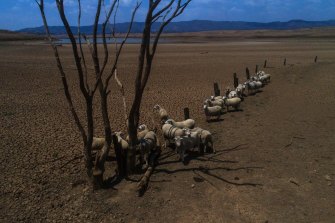
Sheep on the parched lake floor of the Burrendong Dam. The reservoir, one of the largest in the Murray Darling Basin, was down to about 1 per cent full during the worst of the recent drought.
Sheep on the parched lake floor of the Burrendong Dam.
The reservoir, one of the largest in the Murray Darling Basin,
was down to about 1 per cent full during the worst of the recent drought.
Using coral cores drawn from Indonesian islands, an international research team led by Australians reconstructed climatic conditions in the Indian Ocean over more than 500 years. Of particular interest was a phenomenon known as the positive phase of the Indian Ocean Dipole (IOD).

Read the story from The Age by Peter Hannam - “More drought in Australia's future as weather patterns change.”

24 July, 2016

Few equate different weather patterns with climate change


(Visiting family on Queensland’s Sunshine Coast brought me face-to-face with a changing weather pattern; a change that hasn’t gone unnoticed by the locals, but sadly few equate the differences they are seeing with climate change, with most simply describing the new weather pattern as simply “unseasonable”. On Saturday, July 23, temperatures at Alexandra Headland edged past 30 degrees and many people, including a local real estate agent who had lived in the area all his life, saying “winter is over” – “I’ve never seen anything like it,” he said.

Meanwhile, parts of the Middle-East have experienced record temperatures of 54 degrees – considering that, it is worth noting that the health experts say the human body begins to breakdown at 50 degrees – Robert McLean.)

Scorching days in America's Midwest.
Extreme heat waves like the current string of scorching days in the Midwest have become more frequent worldwide in the last 60 years, and climate scientists expect that human-caused global warming will exacerbate the dangerous trend in coming decades. It comes with potentially life-threatening consequences for millions of people.

Research has shown that overall mortality increases by 4 percent during heat waves compared to normal days in the U.S. A study in the journal Environmental Health Perspectives in 2011 suggested that rising summer temperatures could kill up to 2,200 more people per year in Chicago alone during the last two decades of the 21st century.

"The climate is changing faster than we've ever seen during the history of human civilization on this planet, and climate change is putting heat waves on steroids," Katharine Hayhoe, director of the Climate Science Center at Texas Tech University, said during a news conference on Thursday. "Heat waves are getting more frequent and stronger."

Read the Inside Climate News story - “Sizzling Midwest Feels a Preview of a Hotter Future Climate.”

02 May, 2016

Millions face starvation at climate change tightens its grip on Haiti

Mirene Raymond has farmed rice in Haiti
 for decades, but she says she has
never seen conditions quite so bad, April 2016.
GONAIVES, HAITI — Mirene Raymond hasn’t seen a real downpour since last year. The 69-year-old rice farmer is one of millions at risk of malnutrition and starvation due to the combined effects of climate change and El Niño.

“This is the first time in my life that I’ve seen things this bad,” she told ThinkProgress through a translator. “We’ve had droughts before, but never like this.”

The El Niño weather pattern has caused drier than usual conditions in Haiti that have led officials to declare a national emergency. Climate scientists have warned for years of a stronger impact of El Niño due to rising ocean temperatures. Upward temperature trends have also exacerbated droughts and devastated agricultural production around the world.

Crop losses for this year have already been reported in Haiti. As a drought in the Caribbean stretches into its third year running, Raymond has tapped into all of her reserves. She used to be able to sell much of her harvest, and even buy rice from other farmers, to sell at a higher price at a local market.