nder the heading of “Outlook
declines”, Darren Linton writes in today’s Shepparton
News about “Record heatwave points to dry October, a blow for
farmers, orchardists”.
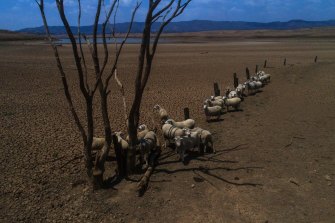
The rainfall for the Goulburn Valley has deteriorated
dramatically forcing the Bureau of Meteorology to issue a special update for
October to December.
After a record heatwave to start October the bureau reissued
its outlook and it makes disturbing reading especially for farmers and orchardist,
The outlook released in late September put the chance of
receiving the average October-December rainfall of 107 mm at 50-50, but that
has now been slashed to 35 per cent around Shepparton and as low as 25 per cent
to the north and across the border.
October will now be particularly dry. The long-term average
of 34 mm is now deemed “very unlikely” with only a 15 per cent change of 25 mm
and only a 50/50 chance of 10 mm.
November is still a 50/50 chance for average rainfall of 37
mm, but overall is for hotter and drier conditions.
The release of the climate outlook special update was due to
a significant shift upwards towards a drier October nation-wide related to the
emerging positive Indian Ocean Dipole reinforcing the strong El Niño.
September rainfall was the third driest on record for
Australia and very low rainfall has been received for the past 12 months in
most of Victoria.
Across most of south-east Australia there is a greater than
80 per cent chance of a drier October and high chances of warmer days and
nights south of the tropics.
The rainfall outlook has shifted up to 40 percentage points
in some area towards a drier October.
“I think people are not surprised to see it go to that level,
but more with the sudden change in 10 days,” Goulburn-Murray Water northern
Victoria systems resources manager Mark Bailey said.
Dr Bailey said the conservative approach to setting
expectations had held customers in good stead so far this season, with general
improvement in water determinations despite declining inflows.
Inflows in the Goulburn system storages from July-September
were 30 per cent of the long-term average, a figure Dr Bailey said would be
exceeded in 95 years out of 100.
“That is saying it is pretty dry,” he said, which is now
likely to continue through October.
“We would have expected a bit during October, it is usually
one of our productive months,” Dr Bailey said.
(Not a word that the
current situation is linked in any way to climate change,reflecting a recent observation
by “Climate Code Red” co-author David Spratt who pointed out that several
reports in the national media about record temperatures in Victoria, a measurable
lack of rain and devastating bushfires also never once mentioned climate
change.)