Showing posts with label without. Show all posts

28 December, 2019

Help! There’s a climate denier at my dinner table

The holidays just aren’t complete without a little drama for dessert. And what’s more dramatic than a planet in crisis?
The drama of having a climate denier for dinner.
The year is winding down and on course to be the second-hottest year on record. Wildfires raged in Alaska and Australia. One neighborhood in the Florida Keys has been underwater for almost three months straight.
The United Nations recently warned that the targets set by the Paris Agreement in 2015 need to be 5 times stronger if the world is going to avoid some of the worst consequences of a warming planet. So maybe now is the time to broach the subject with your “it’s all a hoax” uncle?
According to a recent poll by market research company Morning Consult, 9 percent of Americans plan to talk about climate change at Thanksgiving this year, while another 13 percent expect someone else to mention it.

Read the story from Grist by Kate Yoder - “Help! There’s a climate denier at my dinner table.”

16 September, 2019

Nationals MPs snub launch of farming group's climate change report

Nationals MPs have snubbed a farmers’ group launching a major climate change report that warns the Australian agricultural sector faces “significant threats to viability” without a new national climate strategy.
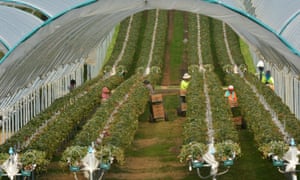
Workers pick raspberries Tasmania
Workers pick raspberries in Tasmania. A Farmers for Climate
 Action report warns of threats to Australian agriculture
without a national climate strategy.
The report, launched by the Farmers for Climate Action group at Parliament House on Monday, warns that agricultural production will fall, farm profits will decline and food insecurity will increase if the government does not come up with a cohesive national strategy on climate change and agriculture.
Lucinda Corrigan, the chair of Farmers for Climate Action, said she had wanted Nationals MPs to attend the event, saying she believed cross-party support was needed given the challenge facing producers.
“It would have been great if they had been there because they need to take this seriously,” Corrigan said.

Read the story from The Guardian by Sarah Martin - “Nationals MPs snub launch of farming group's climate change report.”

25 March, 2019

Quantifying our Faustian bargain with fossil fuels

The climate system will heat well past 1.5 degrees Celsius (°C) and perhaps up to 2°C without any further fossil fuel emissions. That’s the conclusion to be drawn from new research which should also help demystify the rhetoric from the 2015 Paris climate talks of keeping warming to below 1.5°C .
Our Faustian bargain: the byproduct of burning dirty 
fossil fuels are short-lived atmospheric aerosols 
which provide temporary cooling.
It’s not that 1.5°C isn’t dangerous: in fact, at just 1–1.1°C of warming to date, climate change is already dangerous. A safe climate would be well below the present level of warming, unless you think it is OK to destroy the Arctic ecosystem, tip West West Antarctic glaciers into a self-accelerating melt, and lose the world’s coral reefs, just for starters.


Read the story from Climate Code Red by David Spratt - “Quantifying our Faustian bargain with fossil fuels.”

(Listen to David Spratt on "Climate Conversations")

23 March, 2019

WA’s rejection of carbon-neutral guidelines leaves LNG emissions booming

A Western Australian government decision to reject guidelines requiring major liquefied natural gas (LNG) projects to be carbon neutral leaves Australia without a state or federal policy to address its biggest source of growth in heat-trapping emissions.
Chevron was required to offset some of the emissions from
 Wheatstone refinery, but the requirement was dropped by
the former Liberal state government when a national carbon
price was introduced in 2011. It still has not been reinstated.
The most recent federal government emissions report says the booming northern WA LNG industry is the main driver of an 0.9% increase in national emissions in the year to September, continuing a trend in place since 2015. LNG exports to Asian markets jumped 19.7% over those 12 months.

Authorities had hoped the rise in LNG emissions would be slowed by a carbon capture and storage project at the country’s largest natural gas development, Chevron’s Gorgon operation in the Pilbara, coming online early this year.


Read the story from The Guardian by Adam Morton - “WA’s rejection of carbon-neutral guidelines leaves LNG emissions booming.”

30 July, 2018

PM personally approved $443m fund for tiny Barrier Reef foundation

Malcolm Turnbull was at the meeting where $443.8m in funding was offered to a small not-for-profit foundation without a competitive tender process or any application for the money, an inquiry has heard.
Josh Frydenberg and Malcolm Turnbull both attended a meeting
with a small not-for-profit foundation that was offered $443.8m
in funding without a tender.
Anna Marsden, the managing director of the Great Barrier Reef Foundation, told a Senate inquiry on Monday the organisation was offered the funding at a meeting in Sydney in April between Turnbull, environment and energy minister Josh Frydenberg, the foundation’s chair John Schubert and environment and energy department secretary John Pratt.

The inquiry is examining the process by which the foundation, which had just six full-time staff at the time, was awarded the funds and whether it has the capacity to deliver work required under the government’s reef 2050 plan.


Read the story from The Guardian by Lisa Cox - “PM personally approved $443m fund for tiny Barrier Reef foundation.”

15 March, 2018

Climate wars have cost us the chance to lead

The climate wars between the major political parties have cost us a host of lost business and employment opportunities, even a global leadership role, and yet we drift on without an energy policy that might provide some relief to rising power costs and some strategy to meet our commitments to reduce emissions.
John Hewson takes us through the climate wars.
The government’s most recent policy, the National Electricity Guarantee (NEG), is the fourth most effective response, only being proposed after an emissions trading scheme, an emissions intensity scheme and Finkel’s clean energy target were sequentially rejected.

In this sense, the guarantee is the last, and only, game in town, but it is still likely to be exhaustively debated, mostly for not moving fast or far enough, with concern about the longer-term future of the renewables sector.


Read John Hewson’s opinion piece from The Age - “Climate wars have cost us the chance to lead.”

27 February, 2018

Today is National Skip the Straw Day

Order your next drink without a straw and talk to local businesses about why they should #breakfreefromplastic.
Order your next drink without a straw and talk with the shop
owner about why they should #breakfreefromplastic.
Today is National Skip the Straw Day. It always falls on the fourth Friday of February, and is a reminder of how important it is to move away from using single-use, disposable plastics in our everyday lives. 

The National Park Service estimates that Americans use 500 million straws daily, which means that if everyone observed Skip the Straw Day, that would be 500 million fewer straws getting tossed today. 

That is a lot of straws, roughly enough to fill 127 school buses daily and circle the Earth's circumference 2.5 times.


Read the Treehugger story by Katherine Martinko - “Today is National Skip the Straw Day.”

11 February, 2018

Power companies forced to pay $5 million in compensation to Victorians hit by blackouts

Power companies are being forced to pay compensation to Victorians affected by last month's blackouts, with payments up to $180 depending on how long a household went without electricity.

As part of the $5 million package, announced on Sunday, around 50,000 households who lost power on January 28 will receive a one-off payments.

Energy Minister Lily D'Ambrosio said $180 would be given to those without power for between 20 and 30 hours, while those affected for between three and 20 hours would receive $80.


01 February, 2018

Quantifying our Faustian bargain with fossil fuels

The climate system will heat well past 1.5 degrees Celsius (°C) and perhaps up to 2°C without any further fossil fuel emissions. That’s the conclusion to be drawn from new research which should also help demystify the rhetoric from the 2015 Paris climate talks of keeping warming to below 1.5°C .

Our Faustian bargain: the byproduct of burning dirty
fossil fuels are short-lived atmospheric aerosols
which provide temporary cooling

It’s not that 1.5°C isn’t dangerous: in fact, at just 1–1.1°C of warming to date, climate change is already dangerous. A safe climate would be well below the present level of warming, unless you think it is OK to destroy the Arctic ecosystem, tip West West Antarctic glaciers into a self-accelerating melt, and lose the world’s coral reefs, just for starters.

The new research quantifies the effect of losing the very temporary planetary cooling provided by atmospheric aerosols.
Aerosols (including black-carbon soot, organic carbon, sulphates and nitrates and dust) are very short-lived particles in the atmosphere that have a cooling impact that lasts around a week. Most of these aerosols are anthropogenic, that is produced by human activity, and most of the anthropogenic aerosols are a byproduct of the extraction and burning of fossil fuels. Perhaps best known are the polluting sulphates and nitrates from coal-fired power stations, that combine with water molecules in the atmosphere to produce what is popularly known as “acid rain”.


Read the Climate Code Red story by David Spratt -“Quantifying our Faustian bargain with fossil fuels.