Showing posts with label Ethiopia. Show all posts

05 March, 2020

How hundreds of small ‘Gardens of Eden’ guard against total deforestation in Ethiopia

Ethiopia’s northern highlands were once covered by trees. But over the past century, development and exponential population growth have all but wiped out the region’s forests, transforming the landscape into an expanse of brown fields, given over to cattle grazing and agriculture. 
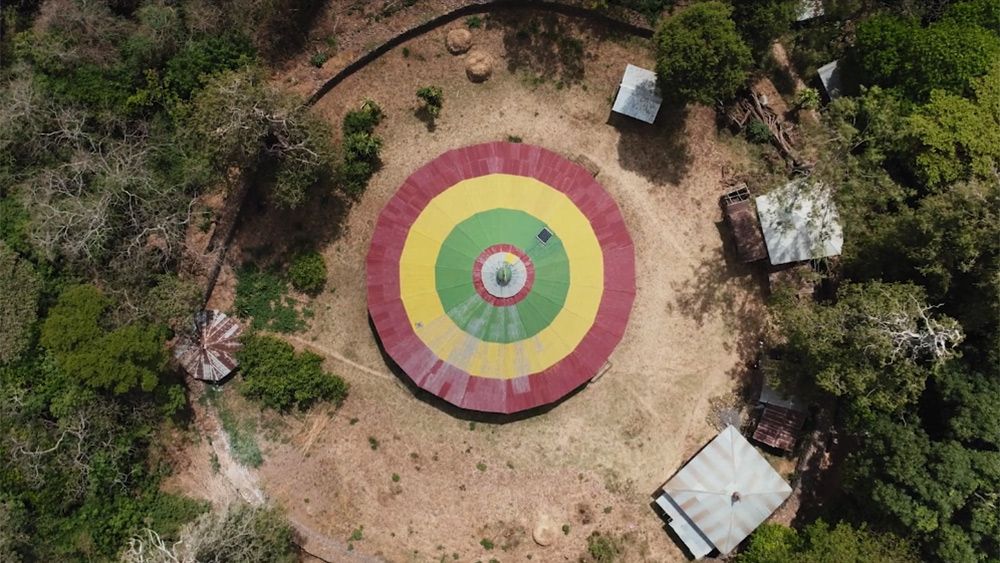
Image result for How hundreds of small ‘Gardens of Eden’ guard against total deforestation in Ethiopia
The small gardens of Ethiopia guard against deforestation.
However, an aerial view of the region reveals small pockets of green with round buildings in the middle, dotting the barren expanses. 

Born of the centuries-old belief of the Ethiopian Orthodox Tewahedo Church that churches should be surrounded by forests so as to resemble the Garden of Eden, these sites have become valuable sanctuaries of biodiversity amid the extreme pressures of population growth.


03 August, 2019

Ethiopia plants 350m trees in a day to help tackle climate crisis

About 350m trees have been planted in a single day in Ethiopia, according to a government minister.

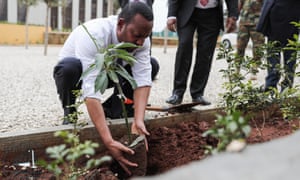
The prime minister, Ahmed Abiy, plants a tree in Addis Ababa, Ethiopia.
The prime minister, Abiy Ahmed,
plants a tree in Addis Ababa.
The planting is part of a national “green legacy” initiative to grow 4bn trees in the country this summer by encouraging every citizen to plant at least 40 seedlings. Public offices have reportedly been shut down in order for civil servants to take part.

The project aims to tackle the effects of deforestation and climate change in the drought-prone country. According to the UN, Ethiopia’s forest coverage was just 4% in the 2000s, down from 35% a century earlier.


Read the story from The Guardian by Anna Ploszajski - “Ethiopia plants 350m trees in a day to help tackle climate crisis.” 

01 April, 2017

Indian Niño brings devastating drought to East Africa

A severe drought threatens millions of people in East Africa. Crop harvests are well below normal and the price of food has doubled across much of Ethiopia, Kenya, Somalia and nearby countries.
Sea surface temperature anomalies during Indian
Ocean Dipoles. Arrows indicate wind direction, white
 patches are areas with more clouds and rain.
The last major drought in the region, in 2011, caused hundreds of thousands of deaths. They are becoming more frequent and more intense – and each has a disastrous impact on the economies of nations and livelihoods of people.

So what is causing these droughts? And why are they becoming more common?

At least part of the explanation lies with a climate phenomenon known as the “Indian Ocean Dipole”. The dipole, often called the Indian Niño due to its similarity with El Niño, is not as well known as its Pacific equivalent. Indeed, it was only properly identified by a team of Japanese researchers in the late 1990s.


Read Rob Marchant’s story on Indian Climate Dialogue -  “Indian Niño brings devastating drought to East Africa.”

25 April, 2016

Women are on the front line of confronting climate change


‘Natural resource scarcity and unpredictable weather affect women first, yet they’re often the last to be heard on how to combat it. That’s slowly changing’

The almost unheralded work of Water1st
International has changed the lives of
many women who are on
the front line of dealing with climate change.
Marla Smith-Nilson has completed more than 1,500 water sanitation projects as founder and executive director of Water1st International, but there’s a moment she still anticipates at the completion of each one.

At every ribbon-cutting ceremony for new groundwater wells, a woman from the community—whether in Bangladesh, Honduras, Ethiopia, or India—stands on stage with a large pot that has served as her companion during daily, mile-long treks to the river. Sometimes the woman is young. Sometimes she’s as old as 75. She raises the pot over her head and shouts “I will never carry this again!” before smashing it to the ground where it explodes into shards.

The community laughs as the pot shatters, but it’s the women in the crowd who feel the most relief. As primary caregivers, many women in poorer countries are responsible for trekking miles to collect water and fuel. When climate change depletes water, women notice first. Water is a climate change issue, and climate change is a women’s issue.

Read the Yes! story - “Why Fixing Climate Change Is Women’s Work.”

02 November, 2015

UK aid goes to fossil fuels projects as opposed to renewables


B
ritain’s overseas aid for energy projects has given twice as much to fossil fuel ventures as renewables, undermining attempts to tackle climate change.

The UK has invested £5bn for energy in developing countries such as Ethiopia, Bangladesh, Nepal and Afghanistan – ranging from loans to grants – between 2009 and 2013.

More than £2bn went to fossil fuels such as oil, coal and gas, 43 per cent of the total. Only around £1bn went on renewable forms of energy such as wind or solar power, 19 per cent of the total.

12 June, 2015

Ethiopia's commitment to curb GHG sets a high bar


E

thiopia has made an ambitious commitment to curb its greenhouse gas emissions between now and 2030, according to Kelly Levin, David Rich and Eliza Northrop of the World Resources Institute.

They write on the Thomson Reuters Foundation website that Ethiopia, one of Africa’s most vulnerable nations, and the first least developed country to submit its Intended Nationally Determined Contribution (INDC) to the U.N., has set a high bar for similar countries.

 Framework Conventionon Climate Change (UNFCCC), Ethiopia communicated its plans to cut emissions below 2010 levels from 150 megatonnes of carbon dioxide equivalent (Mt CO2e) in 2010 to 145 MtCO2e in 2030.

“This represents a major shift,” the authors write, “since conventional economic growth would more than double Ethiopia’s greenhouse emissions by 2030.”