Showing posts with label coal-fired power stations. Show all posts

24 April, 2020

Action looms over 'steep, unexplained' spike in power plant pollution

Environment and health groups have launched legal complaints against the operators of coal-fired power stations in Victoria and NSW after new data revealed huge increases in dangerous particulate pollution from their plants.
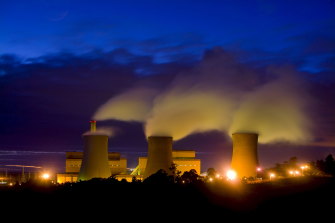
Steam pours out of the cooling towers at Yallourn power station.
Steam pours out of the cooling towers at Yallourn power station. 
In NSW, the Environment Protection Authority has confirmed it will conduct an investigation.
In Victoria, a legal complaint lodged with the state’s Environment Protection Authority calls for an investigation into EnergyAustralia – the owners of the Yallourn power station – over alleged pollutant breaches.
A coalition of Victorian groups, including Environmental Justice Australia and Doctors for the Environment, say Yallourn increased emissions of PM10 coarse-particle pollution by 45 per cent in the most recent reporting year, despite one of its generating units being offline for maintenance during that time.
Read the story from The Age by Miki Perkins - “Action looms over 'steep, unexplained' spike in power plant pollution.”

21 June, 2019

Emissions Reduction Fund review considers opening the scheme to coal-fired power stations

The federal fund set up to fight climate change and reduce Australia's carbon emissions could be used to help extend the life of coal-fired power stations — an idea labelled "insane" by one expert.

Vales Point Power Station.
The owners of Vales Point power station applied
for ERF funding to replace turbine blades.
The independent committee overseeing the Emissions Reduction Fund (ERF) is considering the idea as part of a review into the Federal Government program.

The ERF helps pay for projects, including tree planting and installing energy-efficient appliances, to help Australia meet its global reduction targets.

As part of the review, the independent Emissions Reduction Assurance Committee (ERAC) is considering whether changes are needed to how projects are assessed and which qualify for taxpayer-funded carbon credits — the assessment style is called 'the facilities method’.


(“Insane” is a somewhat tame indictment of Australian government’s plan use cash from a fund set up to fight climate change to extend the life of coal-fired power stations - Robert McLean)

20 May, 2019

Coal industry urges re-elected Morrison government to build new coal plants

The coal industry has begun lobbying the re-elected Morrison government to support hardline positions, including building new coal-fired power stations and weakening approvals processes for new mines.
Australia’s coal industry is lobbying the Coalition to
build new coal-fired power stations and weaken
approvals processes for new mines.
The Coal Council of Australia released a statement on Sunday welcoming the election result, praising the Coalition for supporting coal, and calling on Labor to reverse many of its climate-focused policies towards the fossil fuel.

“While elections are about an array of issues, it is important to note in coal-related electorates in both NSW and Queensland, Labor members and candidates recorded strong swings against them,” the CCA chief executive, Greg Evans, said.

In the three electorates home to most of Australia’s large coalmines – Dawson and Capricornia in Queensland and Hunter in NSW – voters delivered double-digit swings to the government.


Read the story from The Guardian by Ben Smee - “Coal industry urges re-elected Morrison government to build new coal plants.”

20 March, 2019

Here’s why Australia needs to keep subsidising renewables

Conservatives love subsidies because they know that they work. It’s why they spend $11bn subsidising private schools and $6bn subsidising private health insurance. It’s why they’re so keen to subsidise new coal mines and coal-fired power stations. And of course, it’s the reason that they are so obsessed with renewable energy subsidies — they know just how effective they would be.
Subsidies that encourage people to install solar and
batteries on their homes speed up the rate at which
 renewables squeeze the coal-fired power stations
 out of business.
There are those who think mining more coal is a good way to reduce greenhouse gas emissions and then there are those who don’t. I’m definitely one of the latter. And for those who want to see Australia’s emissions fall, there is no doubt that we need more subsidies for renewables.


Read the comment from The Guardian by Richard Denniss - “Here’s why Australia needs to keep subsidising renewables.”

30 October, 2018

Hot farmer anger as climate, drought trends ignored by politicians

Farmers are angry and perplexed by former Nationals federal leader Barnaby Joyce’s obsession with promoting coal-fired power stations and a deep-seated reluctance by some politicians to acknowledge Australia’s carbon emissions must be curtailed.
Farmers' anger over the Federal Government's inattention
 to climate change mitigation and so the present drought is
 equalled only by the Earth's rising temperatures.
As increasing climate variability threatens to cut our agricultural productivity 10 per cent in the next 20 years, farmers generally feel cheated and fed up with the political manoeuvring and denials of the need for practical policies on energy, climate change and drought says fast-growing national lobby group, Farmers for Climate Action (FCA).

While the rural sector was worried by soaring electricity prices, FCA argued most producers were just as fearful about by Canberra’s procrastinating and bitter internal conflicts over carbon pricing, emission issues and its indifference to renewable energy opportunities in regional Australia.

“I get calls every day from mainstream farmers outraged at how government has handled this issue,” said chief executive officer, Verity Morgan-Schmidt.


Read the story from Farmersonline by Andrew Marshall - “Hot farmer anger as climate, drought trends ignored by politicians.”

18 July, 2018

Power price hikes not inevitable, regulator insists

A mammoth investment in the electricity grid will “not necessarily” lead to price hikes over the years ahead, consumers are being told, amid a new political storm over the future of Australia's coal-fired power stations.
AEMO chief executive Audrey Zibelman with
Energy Minister Josh Frydenberg last year.
The Australian Energy Market Operator issued the assurance after predicting it would cost $8 billion to $27 billion over the coming decades to deal with the “disruption” across the network from the shift to renewable power.

Audrey Zibelman, chief executive of the Energy Market Operator, said the new investment would be needed to adapt the east-coast electricity grid as coal power stations closed, but she argued this would not have to mean an increase in prices.


Read the story by David Crowe from The Age - “Power price hikes not inevitable, regulator insists.”

15 August, 2017

Black hole': Pollution from coal-fired power worse than overseas, survey finds

Australia's biggest coal-fired power stations are permitted to dump toxic pollutants on nearby populations far in excess of overseas counterparts, even those in China, a survey by Environmental Justice Australia found.

A survey of 10 of Australia's biggest coal-fired
 power stations finds them lagging internationally
 on most areas of pollution controls.
The study of 10 of the largest plants in NSW, Queensland and Victoria shows limits of key pollutants – such as sulfur dioxide, nitrogen oxides and particulates – typically far exceed those in US, European Union and China.

The Toxic and Terminal report said that 900,000 people live "dangerously close" to power stations, with their pollution well-documented as causing increased levels of asthma, respiratory illnesses and heart disease.

Prevailing winds meant people living further away were also exposed, with some 87 per cent of Sydney's sulfur dioxide pollution derived from five coal-fired power stations in the Hunter.


Read Peter Hannam’s story in today’s Melbourne Age - “‘Black hole': Pollution from coal-fired power worse than overseas, survey finds.”

19 February, 2017

As Australia scorches, sea ice spread around Antarctica hits a record low

A crack in the Larsen C ice shelf
grew 17 kilometres in December.
 
As parts of Australia set heatwave records and the government considered building new coal-fired power stations, the vast continent to the south last week quietly marked a milestone.

The spread of sea ice around Antarctica melted to the lowest level recorded.

"It's a new record, and it might actually go a little bit further south yet this summer," said Jan Lieser, a marine glaciologist with the Antarctic Climate and Ecosystems Cooperative Research Centre in Hobart.

It is the latest in a string of events this summer that has increased global attention on the southern continent, which is home to 90 per cent of the world's ice.


Read Adam Morton’s story in today’s Melbourne Age - “As Australia scorches, sea ice spread around Antarctica hits a record low.”

29 November, 2016

Coal station closures inevitable, start planning: Labor and Greens

The Hazelwood power station
will close in March.
Many of Australia's coal-fired power stations will shut in coming years no matter what the government does, but a national plan will be needed to ensure the lights stay on and price rises are limited while they are replaced with cleaner models, Labor and the Greens say.

A Senate inquiry into the retirement of coal plants heard that many energy companies, unions, community and environment groups agreed closures were inevitable and want the federal government to introduce policies to help manage the shift.

Businesses making this case included AGL, the owner of the most coal-fired power generation capacity in the country.

The Greens-Labor dominated interim committee report says: "The question is not if coal fired power stations will close, but how quickly and orderly these closures will occur and what supporting policies if any will be in place to help manage the process.

Read Adam Morton’s story in today’s Melbourne Age - “Coal station closures inevitable, start planning: Labor and Greens.”

26 September, 2016

Dutch parliament votes to close down country's coal industry

Five Dutch coal-fired power stations were closed
 last year but the country still has another five
 plants in operation, three of which came online in 2015.
The Dutch parliament has voted for a 55% cut in CO2 emissions by 2030, which would require the closure of all the country’s coal-fired power plants.

The unexpected vote on Thursday night by 77 to 72 would bring the Netherlands clearly into line with the Paris climate agreement, with some of the most ambitious climate policies in Europe.

It is not binding on the government, but the Liberal and Labour parties say they will now push for speedy implementation of the motion.

Five Dutch coal-fired power stations were closed last year but the country still has another five plants in operation. Three of these came online in 2015, and have been blamed for a 5% rise in the country’s emissions last year.

10 August, 2015

Community concerned Coalition ignoring climate change


A

ustralians are deeply worried the Abbott government is underestimating the importance of climate change, new polling shows, as cabinet debates crucial long-term targets for greenhouse gas reductions.

The annual polling by the Climate Institute thinktank reveals Australians overwhelmingly support wind and solar energy – as the Coalition seeks to limit support for both – and see it as inevitable that coal-fired power stations will have to be phased out and replaced.

19 June, 2015

Skeptics delighted to hear about wind farm procrastination


C

limate change skeptics would be delighted to hear about the further procrastination about wind power as a renewable energy.

Senator John Madigan - he is "sitting on
 the fence" about wind farms.
Endless research has illustrated the no ill health effects are connected to wind turbines, but still we argue about their safety and impact on human health, while a power generating system we know has massive impacts continues without serious challenge.

Coal-fired power stations, we know, are changing the world’s climate system, risking the lives of billions, and again we know, many people die every year to coal related illnesses and yet it is an issue governments rarely confront.

No doubt to the delight of the skeptics further procrastination is proposed as Senator John Madigan steps up to defend his idea that there should be further scrutiny of wind turbines.