Showing posts with label England. Show all posts

16 September, 2019

Climate change is threatening to break cricket apart, from putting players in danger to disrupting matches

When I was in the middle of treatment for cancer a few years ago, the place I’d go for comfort was my local cricket ground.
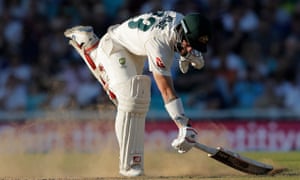
Matthew Wade scampers a quick single during day four of the England v Australia 5th Ashes test match at The Oval on September 15th 2019 in London (Photo by Tom Jenkins)
“Unless we act, extreme heat will worsen. This will result in
more games being postponed, poorer performance because
 of heat influenced cognitive deterioration and increased
 likelihood of heat exhaustion and heat stroke.”
One reason I found this place so comforting while being physically and emotionally demolished by chemotherapy were the friendships I’d made from years of playing, coaching and cooking thousands of sausages.
When confronted with a nasty tumour that seemed hellbent on trying to kill me, my cricket club helped keep me sane. The friendships made on and around the ground were the source of love and humour that made it possible for me to withstand a really crap experience.
The game is important to me because I know at its best it unites individuals who then become capable of doing great things together.
Anyone who has seen the Adam Goodes films knows sport is about much more than games. It’s a window into who we are as a community – for good or ill.
At my own community cricket club the game is a glue binding together people born in Sri Lanka, India, Pakistan, New Zealand, Zimbabwe, South Africa, England and Australia.
Climate change threatens to break cricket apart.

17 January, 2019

Glaciers Are Retreating. Millions Rely on Their Water

On a summer day in the mountains high above Almarty, Kasakhstan’s large city, the Tuyuksu glacier is melting like mad, Rivulets of water streaming down the glacier’s thin leading edge.
Glaciers are retreating and millions rely on them for water.
As she has for nearly two decades, Maria Shahgedanova, a glaciologist at the University of Reading in England has come to check on the Tuyuksu. One of the longest studies glaciers anywhere, the Tuyuksu helps gauge the impact of climate change on the world’s ice.

With colleagues from the Kazakhstan Institute of Geography, Dr. Shahgedanova has made the slow trip from Almarty, 15 miles to the north and nearly two miles below, lumbering up a steep, rutted mountain road in a giant Russian utility vehicle.


Read the story from The New York Times by Henry Fountain and Ben C. Soloman - “Glaciers Are Retreating. Millions Rely on Their Water.”

28 March, 2018

Bottle and can deposit return scheme gets green light in England

All drinks containers in England, whether plastic, glass or metal, will be covered by a deposit return scheme, the government has announced.
 Deposit return schemes currently operate in 38 countries. 
The forthcoming scheme is intended to cut the litter polluting the land and sea by returning a small cash sum to consumers who return their bottles and cans.

Similar schemes operate in 38 countries, and campaigners have worked for a decade for its introduction in England.

Fees vary depending on the size of the bottle or can and many use “reverse vending machines” to automate the return.


Read Damian Carrington’s story from The Guardian - “Bottle and can deposit return scheme gets green light in England.”

05 January, 2016

Spate of extreme weather events tell a deadly tale

December witnessed a spate of extreme global weather events, from deadly tornadoes in the southern U.S. to bushfires in Australia — and the latest development is a series of record-breaking floods in the United Kingdom, brought on by torrential rain starting in the first week of the month.

Thousands of homes in the north of England are believed to have been affected already, and the region is reeling again from a new wave of flooding just brought in this week with the onset of Storm Frank.

05 June, 2015

'Bladeless' wind turbines welcomed by biggest critics


A

 more efficient and less intrusive wind turbine design has been welcomed by two of the UK industry’s biggest critics and government regulators.

Bladeless wind turbines are
reshaping the debate.
A new bladeless wind turbine that promises to be more efficient, less visually intrusive, and safer for birdlife than conventional turbines has been welcomed by two of the UK wind energy industry’s most vocal critics.

The RSPB and the Campaign to Protect Rural England (CPRE), which have both expressed concerns over the impacts of industrial-scale windfarms on the landscape and wildlife, said the new turbine was encouraging news for birds and had the potential to open up more urban environments to the sector.

The streamlined design contains no contacting moving parts, making it virtually noiseless and less prone to vibration. Vortex Bladeless, the turbine’s Spanish developers, hopes these advantages could finally help usher in a viable consumer wind power market.

28 May, 2015

Frequency of extreme weather events warrants climate change epithet


E

xtreme weather events rarely warrant the epithet of climate change when considered in isolation.


Dorothea Mackellar - many
 climate change doubters
escape to and draw comfort
from her 1906
 poem, "My Country".

The attribution for responsibility is quickly pinned on climate change immediately frequency and severity are entered into the equation.

This century, not yet even 15-years-old yet, has seen Australia peppered with extreme weather events, including devastating bushfires, floods and cyclones, and yet we have government that invariably seeks comfort in the Dorothea Mackellar poem, “My Country”.

Mackellar, who was not climate scientist and during a bout of homesickness in England early last century wrote:
 
“I love a sunburnt country,
A land of sweeping plains,
Of ragged mountain ranges,
Of droughts and flooding rains.”

That simple, but moving poem is often trotted out to explain, or justify, why Australia is being repeatedly assaulted by extreme weather events, almost as if a lonely and homesick poet of 19 new more early in 20th Century than our highly trained scientists of the 21st Century.

Just as we have seen a preview of the extreme weather ahead, it’s now argued in a Huffington Post story that “Texas Flooding Could Be A Preview Of Future Extreme Weather Events”.

04 May, 2015

England is set to swelter through hot years - Andrew King


A

ndrew King writes in The Conversation that “England’s set to swelter through a rash of record hot years”.

The Climate Extremes Research Fellow at University of Melbourne writes: “Last year was probably the hottest on record worldwide.

“On regional and local scales, 2014 also broke many records. Across Europe as a whole, and in 19 individual European countries, it was the warmest year recorded.

“The Central England Temperature series – the longest instrumental temperature record in the world, extending all the way back to 1659 – also experienced its warmest year last year,” he says.

11 December, 2014

Now we are getting 'weather bombs'

Now we are getting, it seems, “weather bombs”.

And what is a “weather bomb?”

According to an ABC story “A weather bomb occurs when storms quickly intensify and pressure drops rapidly.”

The ABC story, headed: “Wild winds and rain from 'weather bomb' sweep across the UK leaving 17,000 without power” tells of heavy rain and winds that hit Scotland, Northern Ireland and northern England overnight with an amber wind warning, meaning there was a potential risk to life and property,