Showing posts with label forests. Show all posts

12 October, 2019

A Season of Fire Tests Indonesia’s Efforts to Curb Deforestation

Indonesia is experiencing another bad fire season, with forests and peatlands burning across much of the country. The fires have forced schools to close, caused respiratory problems for an estimated million people and infuriated neighboring governments.
They have also cast doubt on the effectiveness of Indonesia’s recent efforts to reduce deforestation. 
At issue is whether improvements seen in the past few fire seasons had more to do with the weather — 2019 has been warmer and drier in Indonesia than the past few years — and less with policy changes and better enforcement of environmental laws.

Read the story from The New York Times by Henry Fountain - “A Season of Fire Tests Indonesia’s Efforts to Curb Deforestation.”

21 December, 2017

How climate change makes trees vulnerable to pests

Beetles no bigger than a grain of rice are destroying conifer forests, and their greatest weapon is invisible.
Tiny beetles, huge damage.
Six: “Bark beetles are tiny little insects. They kill trees by actually releasing these odors, these pheromones that attract other beetles to the tree, and if they’re lucky enough to attract literally hundreds to thousands, they can overcome the tree’s defenses and then they can raise their young under the bark.”

Entomologist Diana Six of the University of Montana says that in the past, bark beetle populations were generally not large enough to do widespread damage.

But warmer temperatures are allowing more beetles to survive the winter. And, the longer growing season gives insects more time to reproduce, so populations are booming.


Read The Climate Connections story by Daisy Simmons - “How climate change makes trees vulnerable to pests.”

15 December, 2017

Making the Perfect Ice Storm

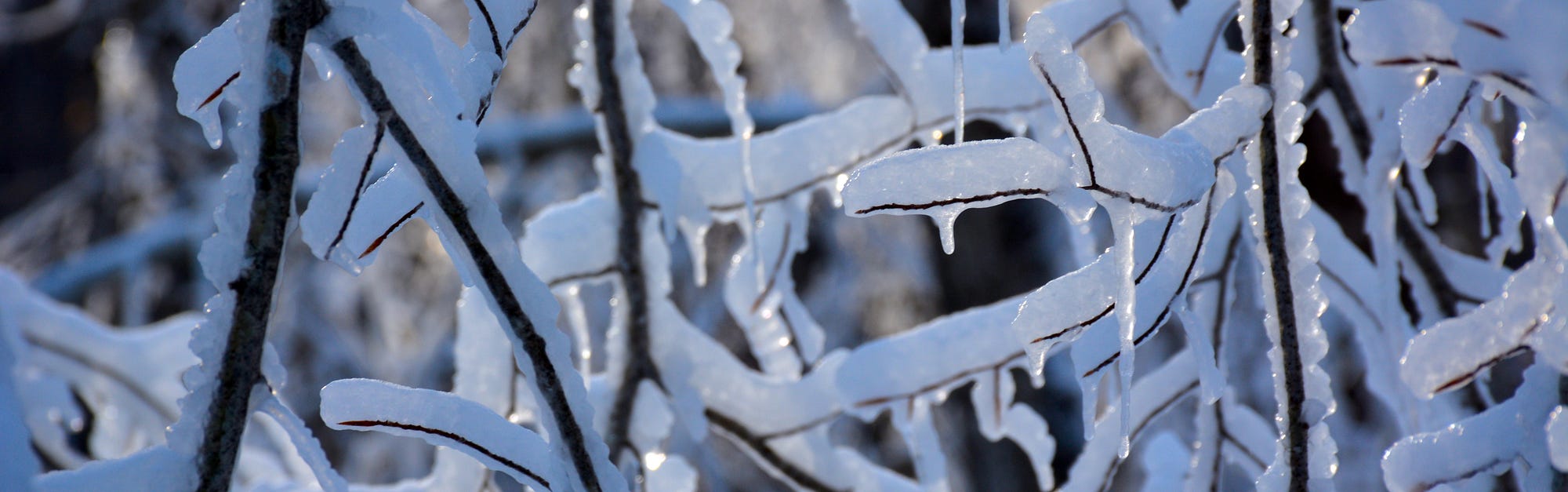
Lindsey Rustad is an ice sculptor. But she doesn’t make the swans you see at weddings or corporate events. She makes ice storms in forests. Her designs, like those in nature, glisten and evoke wonder. But they also foretell danger. With increasing evidence that climate change is driving more frequent and severe weather events, likely including ice storms, she wants to find out what that means for the health of the forest.

Icicles on branches.
Ice storms can be immensely destructive. Frozen limbs, dragged down by the weight of ice, can break, landing on cars, power lines, homes and people. In the United States, such storms cause an estimated 60 percent of winter storm losses, andhere and in Canadabillions of dollars in damage. In January 1998, a massive ice storm devastated parts of northern New England, northern New York and southeast Canada, and a 2008 ice storm in China killed 129 people.


Read the Nexus Media story by Marlene Cimons - “Making the Perfect Ice Storm.”

18 October, 2017

Wildfires sweep Portugal, northern Spain, killing dozens

Lisbon/Madrid: At least 36 people have died in wildfires raging through parched farmlands and forests in Portugal and another three in neighbouring north-western Spain.

Residents walk past a burnt bus as a wildfire moves
forward in Chandebrito in the north-western Spanish
 region of Galicia. 
Firefighters were battling 50 blazes in Portugal and a similar number in Spain on Monday, local time.

Portugal's government has asked for international help and declared a state of emergency in territory north of the Tagus river - about half its landmass.

Flames ripped across Iberian countryside left tinder-dry by an unusually hot summer and early autumn, fanned by strong winds as remnants of ex-Hurricane Ophelia brushed coastal areas.


Read the story by Andrei Khalip and Raquel Castillo in today’s Melbourne Age - "Wildfires sweep Portugal, northern Spain, killing dozens.”

08 October, 2017

Written in King Billy’s tree rings: 1700 years of climate history

Tasmania’s iconic King Billy pines
offer an insight into the area’s
climate history. 
Hikers traversing the world famous Overland Track between Cradle Mountain and Lake St Clair in western Tasmania occasionally find themselves wandering from alpine scrubland into forests of towering King Billy Pines.

Found only in Tasmania, these conifer trees, named for Tasmanian Aboriginal William Lanne (known as King Billy), can live for more than 1000 years, and their wood contains an environmental history of every one of those years.

After eight years of sampling, measuring, cross-referencing and computer matching, an international research team has built a 1700-year King Billy Pine tree ring chronology. It is only the second Australian tree-ring chronology to exceed 1200 years, and it is the first published King Billy Pine chronology to exceed 1000 years.

They also produced reconstructions of historic streamflows in western Tasmania from hundreds of years ago and are working on reconstructing historic temperatures.


Read the story by Eisha Gupta from the University of Melbourne on Pursuit - “Written in King Billy’s tree rings: 1700 years of climate history.”

16 September, 2017

90 Companies Helped Cause the Climate Crisis—They Should Pay for It

Pacific Northwest forests are on fire. Several blazes are out of control, threatening rural towns, jumping rivers and highways, and covering Portland, Oregon, Seattle, and other cities in smoke and falling ash. Temperatures this summer are an average of 3.6 degrees higher than the last half of the 20th century, according to the University of Washington Climate Impacts Group analysis published in The Seattle Times.

Firefighters attempt to save the Casa Loma fire
 station in the Santa Cruz Mountains near Loma
Prieta, California on September 27, 2016.
Fire crews have been battling fires for months. In spite of all the effort, though, officials expect the fires to continue burning until major rains come sometime this fall. Meanwhile, firefighting coffers are running dry as costs run into the hundreds of millions.


Read the Yes! magazine story by Sarah Van Gelder - “90 Companies Helped Cause the Climate Crisis—They Should Pay for It.”

03 August, 2017

Earth Overshoot Day: We used a year's worth of resources in seven months

There is a date every year when the world's resource bank goes into overdraft.

At current rates, we use the resources of 1.7
Earths each year, according to the Global
Footprint Network.
This year, Earth Overshoot Day is marked globally on August 2. For the rest of year we're in the burning red.

It's the point when the amount of natural resources — think trees, fish and water — humanity takes from the Earth reaches the total that can be regenerated over the entire year.

It's when the amount of carbon emitted reaches the amount the forests and oceans are able to absorb.
This year it happened in seven months, according to the Global Footprint Network.


17 June, 2017

We Will Soon Be Using More Than The Earth Can Provide


Four days after President Trump announced the United States would withdraw from the Paris climate agreement, the Global Footprint Network (GFN) reported that Earth Overshoot Day 2017 will fall on August 2. Most Americans likely have no idea what that means.

From January 1 to August 2, the world’s 7.5 billion people
will have used as much of Earth’s biological resources—or
biocapacity—as the planet can regenerate in a year.
The basic point is quite simple: From January 1 to August 2, the world’s 7.5 billion people will have used as much of Earth’s biological resources—or biocapacity—as the planet can regenerate in a year. During the remaining five months of 2017, our human consumption will be drawing down Earth’s reserves of fresh water, fertile soils, forests, and fisheries, and depleting its ability to regenerate these resources as well as sequester excess carbon released into the atmosphere.


Read the Yes! magazine story by David Korten  - “We Will Soon Be Using More Than The Earth Can Provide.

07 August, 2015

UK embarks on 'dream scenario' for fighting climate change


I

t is the dream scenario for fighting climate change: a power station that delivers negative emissions. And it could be coming to the UK, helped along by the growth of forests in the American South and some handy holes beneath the North Sea.

The giant coal power station at Drax in Yorkshire, with its 12 cooling towers, is one of the world’s largest greenhouse gas emitters. It sends some 23 million tonnes of carbon dioxide up its stacks each year, while supplying up to a tenth of the UK’s power.

Its owners are now planning to replace coal with wood pellets and bury the emissions. Combined with growing trees to replace all those burned, the mega-polluter could one day be transformed into the world’s largest industrial absorber of CO2.

05 September, 2013

We fiddle about, time marches on and the situation worsens


On a geological time-scale, humans have only been plodding about the earth for an infinitesimal small amount of time.


The Earth is 4.6 billion years old. - let’s scale that to 46 years.
Since the Industrial Revolution
began three centuries ago, we have
destroyed half the world's forests.

We have been here for 4 hours.

Our industrial revolution began 1 minute ago.

In that time, we have destroyed more than 50% of the world’s forests.

And on a human time-scale, we have irreparably damaged our atmosphere; an atmosphere that ensures our climate is habitable for humans.

Unless we change our behaviour dramatically, and quickly, our time on earth is limited.