Showing posts with label global emissions. Show all posts

05 December, 2019

Global emissions to hit 36.8 billion tonnes, beating last year’s record high

Global emissions for 2019 are predicted to hit 36.8 billion tonnes of carbon dioxide (CO), setting yet another all-time record. This disturbing result means emissions have grown by 62% since international climate negotiations began in 1990 to address the problem.
Image result for Global emissions to hit 36.8 billion tonnes, beating last year’s record high
Coal emissions are falling, but gas and coal
 use are strongly rising around the world.
The figures are contained in the Global Carbon Project, which today released its 14th Global Carbon Budget
Digging into the numbers, however, reveals a silver lining. While overall carbon emissions continue to rise, the rate of growth is about two-thirds lower than in the previous two years.
Driving this slower growth is an extraordinary decline in coal emissions, particularly in the United States and Europe, and growth in renewable energy globally. 

04 December, 2019

Carbon Dioxide Emissions Hit a Record in 2019, Even as Coal Fades

WASHINGTON — Emissions of planet-warming carbon dioxide from fossil fuels hit a record high in 2019, researchers said Tuesday, putting countries farther off course from their goal of halting global warming.
The new data contained glimmers of good news: Worldwide, industrial emissions are on track to rise 0.6 percent this year, a considerably slower pace than the 1.5 percent increase seen in 2017 and the 2.1 percent rise in 2018. The United States and the European Union both managed to cut their carbon dioxide output this year, while India’s emissions grew far more slowly than expected.
And global emissions from coal, the worst-polluting of all fossil fuels, unexpectedly declined by about 0.9 percent in 2019, although that drop was more than offset by strong growth in the use of oil and natural gas around the world.
Scientists have long warned, however, that it’s not enough for emissions to grow slowly or even just stay flat in the years ahead. In order to avoid many of the most severe consequences of climate change — including deadlier heat waves, fiercer droughts, and food and water shortages — global carbon dioxide emissions would need to steadily decline each year and reach roughly zero well before the end of the century.

Read the story from The New York Times by Brad Plumer - “Carbon Dioxide Emissions Hit a Record in 2019, Even as Coal Fades.”

03 May, 2019

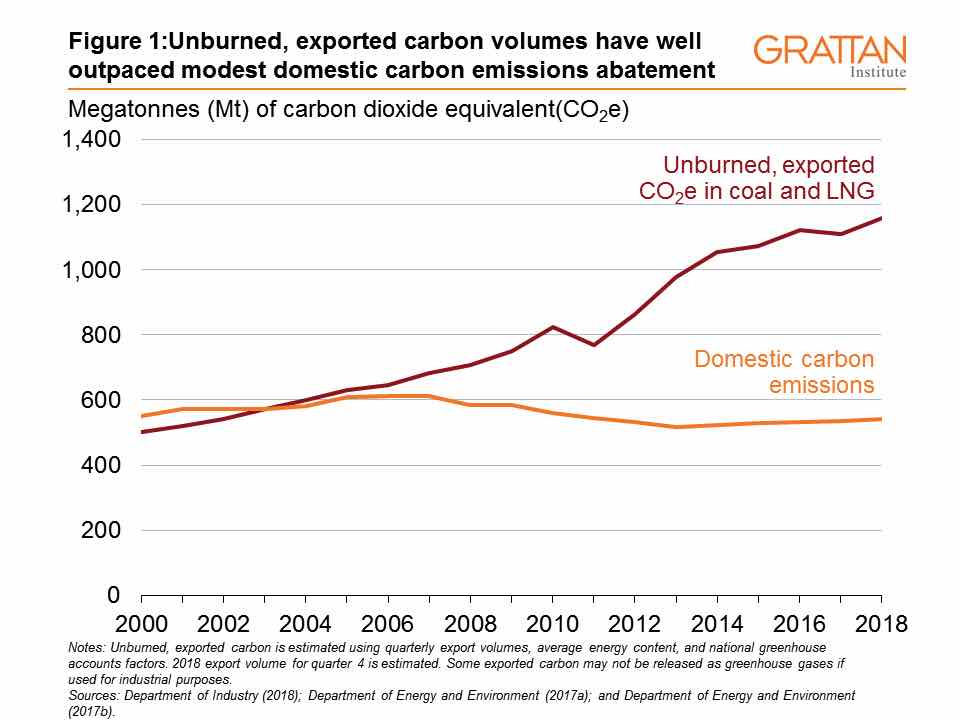
Global emissions from Australian carbon exports dwarf any domestic cuts.

Global emissions released overseas from coal and gas exported from Australia have more doubled since 2000, and are now more than double Australia’s domestic emissions.


Depending on who you ask, carbon emissions in Australia are either rising, or falling. What is undeniable is that recent increases in emissions from Australia’s fossil fuel exports dwarf any domestic reductions.


Read the story from RenewEconomy by Lucy Percival - “Global emissions from Australian carbon exports dwarf any domestic cuts.

10 December, 2018

We are in trouble.’ Global carbon emissions reached a record high in 2018

Between 2014 and 2016, emissions remained largely flat, leading to hopes that the world was beginning to turn a corner. Those hopes appear to have been dashed. In 2017, global emissions grew 1.6 percent. The rise in 2018 is projected to be 2.7 percent.


Global emissions of carbon dioxide are reaching the highest levels on record, scientists projected Wednesday, in the latest evidence of the chasm between international goals for combating climate change and what countries are doing.


Read the story from The Washington Post by Brady Dennis and Chris Mooney - “‘We are in trouble.’ Global carbon emissions reached a record high in 2018.”

13 October, 2016

Methane emissions far higher than previously thought

Methane emissions are '60 to 110
percent greater than
current estimates', study says.
Global emissions of the potent greenhouse gas methane may be double current estimates, posing a serious new challenge in the fight against climate change, researchers say.

The new study is based on a database 100 times larger than previous ones, and uses a methodology that avoids debatable assumptions underlying earlier models.

Within the figure, the methane leaked during the production and use of natural gas, oil and coal is 20 to 60 percent higher than previously thought, says the study, published in the peer-reviewed journal Nature.   

"Both emissions inventories and atmospheric studies have underestimated methane emissions from fossil fuel development," Stefan Schwietzke, a scientist at the US National Oceanic and Atmospheric Administration and lead author of the study, told AFP news agency.

07 August, 2016

Global climate treaty suggests 'planet doesn't stand a chance'


(The general concept of Naveena is okay, but what troubles me a little are the specifics, and maybe that maybe termed “not-picking”.

The planet Naveena seems so concerned about will be fine, what is facing a serious and almost unstoppably threat, are the “Goldilocks-like” conditions which have allowed humans to thrive and prosper – Robert McLean).

If the climate pledges countries have submitted are any indication of whether the world can save itself with a global climate treaty, the planet doesn't stand a chance.

More than 140 countries have submitted plans to the United Nations Framework Convention on Climate Change on how they will reduce carbon dioxide emissions to fight climate change. These countries account for about 90 percent of global emissions. They form the basis for final treaty negotiations that will take place in Paris in December.

Climate scientists agree that in order to prevent the worst consequences, global warming must be held to within 2 degrees Celsius. The pledges submitted so far will reduce emissions by about 60 gigatons compared to business as usual, but will limit temperature rise to only 3.5 degrees Celsius, according to Climate Interactive, the non-profit tracking the progress of the global climate change movement.

Read Naveena Sadasivam’s Inside Climate News story - “Climate Treaty Forecast: Cloudy With a Chance of Disaster.”

31 October, 2015

INDCs are inadequate to stem global warming: Christina Figueres


P

The United Nation's 
 Christina Figueres.
 
ledges by most of the world’s countries on climate change are likely to lead to less than 3C of global warming over the century, analysis of the data by the United Nations suggests.

The UN praised governments for coming forward with plans to limit their greenhouse gas emissions, to kick in from 2020 when current commitments expire.

The plans from 146 countries that cover nearly 90% of global emissions, known as INDCs or Intended Nationally Determined Contributions in the UN jargon, will form the centrepiece of the make-or-break Paris conference on climate change this December.

11 October, 2015

Inadequate pledges for Paris - planet doesn't stand a chance


I

f the climate pledges countries have submitted are any indication of whether the world can save itself with a global climate treaty, the planet doesn’t stand a chance.

More than 140 countries have submitted plans to the United Nations Framework Convention on Climate Change on how they will reduce carbon dioxide emissions to fight climate change. These countries account for about 90 percent of global emissions. They form the basis for final treaty negotiations that will take place in Paris in December.

Read the Inside Climate News story - “Climate Treaty Forecast: Cloudy With a Chance of Disaster”.

18 March, 2015

Carbon dioxide emissions were halted in 2014


Giles Parkinson from
Reneweconomy.
Carbon dioxide emissions were halted in 2014 even though the global economy grew.

Writing on Reneweconomy, Giles Parkinson, said, “The International Energy Agency has hailed a “surprising” and “unprecedented” halt in the rise of global carbon dioxide emissions – an event it directly credits to the growth in solar and wind power, increased hydro, and the decline in coal-fired generation.”

His story, headed: “Solar, wind power aid unprecedented halt in global emissions”, says, “The IEA says global CO2 emissions stood at 32.3 billion tonnes in 2014, unchanged from the preceding year, despite a 3 per cent increase in global economic growth.”

He writes: “It says this is the first time in 40 years in which there was a halt or reduction in emissions of greenhouse gases that was not tied to an economic downturn such as the global financial crisis.”

14 March, 2015

Surprise, Suprise! Denying climate change is 'plain immoral'


Surprise, surprise!

John Kerry - denying climate
 change is just "plain immoral".
US Secretary of State John Kerry has accused climate deniers of gambling with the well-being of future generations in a recent speech to the Atlantic Council.

“It is just plain immoral,” Kerry said. “And it is a risk that no one should take. We need to face reality. There is no planet B.”

The speech was part of the Atlantic Council’s Road to Paris series, in advance of the 2015 United Nations Climate Change Conference.

The Paris conference is expected to be the first time that each individual country commits to a domestic plan to reduce greenhouse gas emissions.

The agreement may also include a goal on global emissions reductions, as ThinkProgress reported in December.

A story headed: “Kerry: Ignoring Climate Change Is ‘Just Plain Immoral’” tells or Kerry’s disillusionment with climate deniers.