Showing posts with label farming. Show all posts

06 May, 2020

Planners say pandemic shows farmland on city fringes is crucial

If housing keeps concreting over land previously used for farming, they say reliance on imported food will become the norm.
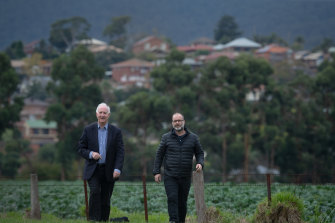
Farmland on Melbourne's city fringe has been central to how well Melbourne is coping during the coronavirus pandemic, academics Michael Buxton (L) and Andrew Butt say.
Farmland on Melbourne's city fringe has been central to
how well Melbourne is coping during the coronavirus
pandemic, academics Michael Buxton (L) and Andrew Butt say.
“Urban sprawl and rural subdivision could halve Melbourne’s peri-urban food production capacity,” said Andrew Butt, from meeting 41 per cent of the city’s current food needs now to just 18 per cent by 2050.
Professor Butt and Michael Buxton, two RMIT planning academics, have this month released a new book, The Future of the Fringe, published by the CSIRO. In it, they show that a quarter of Australia’s agricultural production now comes from land on city fringes.
“In this pandemic, both food production and supply chains have proved increasingly vulnerable,” Professor Buxton said. “Dependency on international and interstate food assumes that stable conditions will continue, but long and complex supply chains can be disastrous in a crisis."
Read the story from The Age by Clay Lucas - “Planners say pandemic shows farmland on city fringes is crucial.”

06 July, 2019

It’s time to change the rhetoric: Farming is part of the answer to net zero emissions

Farming has faced a barrage of criticism recently for its role in climate change.
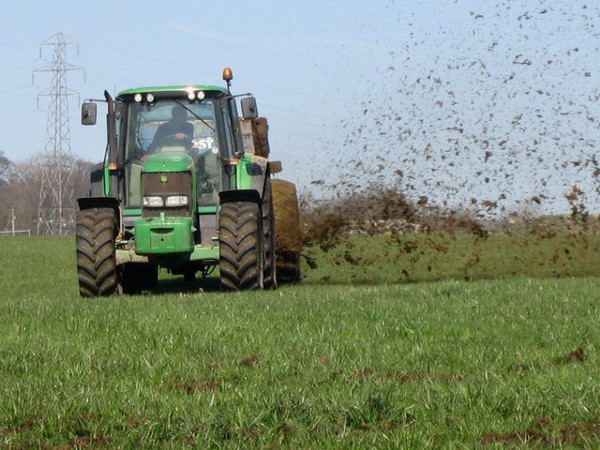
Choosing organic fertilisers over artificial ones can help reduce emissions.
However, much of the rhetoric has failed to highlight or focus on the huge positive contribution agriculture can have in helping the UK reduce greenhouse gas (GHG) emissions.
Hot on the heels of the Committee on Climate Change’s report, Net ZeroThe UK’s contribution to stopping global warming, the government has announced the UK should aim for net zero emissions by 2050.
As part of that goal, it said we should be reducing diet-related emissions by eating less beef, lamb and dairy, and encouraging afforestation of land currently used for farming would help meet these targets.

02 April, 2019

Budgeting for drought

Farming is a risky business. Seasonal conditions are always variable – ranging from drought back to normal and then onto above average rainfall, as well as floods and cyclones. Added to this, commodity prices are volatile.
The current crippling drought hitting eastern
Australia is reducing agricultural output.
The current crippling drought hitting eastern Australia is reducing agricultural output and incomes, as well as causing distress to many rural families across the country. And it could get worse – with climate change likely to increase both the frequency and severity of future droughts.

Most people voluntarily commit to farming if the anticipated returns in the good times balance the low or negative returns during adverse conditions. The majority of farmers and their families prepare for and adjust to the ups and downs of farming – and this includes drought.

But can the same be said for government?

Reed the Pursuit story by Professor John Freebairn from the University of Melbourne

20 April, 2018

Multi-billion-dollar potential for Western Australia's carbon farming industry

A new carbon farming pilot project across the Southern Rangelands could signal the start of a new multi-billion-dollar industry for Western Australian pastoralists.
Station owners believe further tenure reform is needed
before carbon farming will take hold in Western Australia.
This week the State Government gave approvals for WA pastoralists to participate in the Commonwealth's $2.55 billion Emissions Reduction Fund (ERF) and upcoming reverse auction.

Already established in states such as NSW and Queensland, under the scheme land owners are paid for practices that reduce carbon dioxide emissions, like conserving native vegetation on their land.

Landholders can then earn carbon credits for their practices, which they can sell on the carbon market to companies that want to offset their emission costs.

Agriculture Minister Alannah MacTiernan said she hoped the 12-month pilot program would be the first step towards creating an accessible carbon farming industry in WA.


28 December, 2017

The Real Question for Agricultural Sustainability

Sustainable Agriculture is the production of food, fiber, or other plant/animal products using farming techniques that protect the environment, human communities, public health and animal welfare.
The United States, for the geographical nerds out there, is surrounded and protected by two massive bodies of water: The Pacific Ocean and the Atlantic Ocean. Very strategic and the core for the Manifest Destiny of the 19th century.

The essence of agricultural beauty, resources and overall protection from land invasion by a neighboring nation was the main idea for the Manifest Destiny. This article is not to litigate the main purpose of that 19th century idea, but to rather bring to light one of the main pillars for that manifestation: agriculture and crops.


Read Ahmed Maneeb’s story on The Startup - “The Real Question for Agricultural Sustainability.”

06 April, 2015

Shiny packaging covers corporate sins of palm oil


P

alm oil is a much sought after product, so much so that frequently we disregard human and environmental costs.

Easter sees a continuation of how the corporate ills of the world are hidden beneath some shiny packaging, with many of the traditional chocolate Easter eggs being made use palm oil.

Dense and climate sustaining forests are often cleared to allow for palm oil farming and frequently child labour is exploited to ensure production costs are kept as low as possible and, of course, corporate profits at the maximum.

In its story - “Child labour and palm oil lend chocolate Easter eggs a bitter taste” – the Sydney Morning Herald says that a growing number of ethical consumers are looking beyond the shiny packaging to buy chocolate made without the use of child, forced or trafficked labour, and palm oil, an ingredient linked with deforestation, animal cruelty and climate change.

24 October, 2014

Farming our way towards sustainability


Farming, in all its forms and complexity of processes, is a major contributor to the world’s carbon dioxide emissions.

Subsequently, the humble small family farm or the mighty mono-cropping monster has to become sustainable.

Sustainability can be simple or complex, depending on personal interpretation, but whatever view prevails, it is essential that each of us, including farmers, work toward that outcome.

Meanwhile, a story on The Guardian headed: “Investing in sustainable agriculture by converting farms to 'beyond organic'” tells about a San-Francisco based fund aimed at making conventional farms sustainable while providing high returns to investors.

The story reports: “Its newfangled approach moves specialist farmers around the property based on ecology, biodiversity and what’s best for the land in the long run.”

16 February, 2012

Expo can help show the way to a secure future


Farming, depending on how it’s approached, can rescue or condemn us to somewhat difficult times.

Activities engaged in by farmers, or by their industrialized counterparts who claim to be farmers, but which are little more than corporations that desire nothing but financial wealth, play key roles in worsening or improving our climate.

Alternatives open to the farming sector can be seen over three days at the Seymour Alternative Farming Expo that begins on Friday, February 17.

The expo is an outdoor supermarket for leading edge farm machinery, products and services from Australia and around the world and showcases Australia's unique engineered and technical solutions to the challenges of farming on one of the world's driest continents.

Technology at Seymour Expo focuses on advances in alternative livestock, cropping enterprises, small to medium farm machinery, implements and building systems (home and farm).

“The Expo,” the organizers say, “has a strong lifestyle focus including food growing and preparation, animals such as cattle, sheep, goats and backyard chooks.

“Regular event features include the Snake Show, Chainsaw Carving, Working Sheep Dogs, Country Cook Off and the Butchers Shop, Gourmet Food Marquee, The Owner Builder Lectures, Agricultural Society Lectures and the NMIT Ag Zone Lectures,” the say.
The expo is set up at Kings park in Tallarook St, Seymour.