Showing posts with label children. Show all posts

10 January, 2020

Give Kids the Money From Carbon Taxes

Children’s increasing prominence in efforts to slow climate change has provoked mixed reactions. Many, myself included, laud recent Time Person of the Year Greta Thunberg and her fellow youth activists as heroic leaders. Others consider them disrespectful pawns. Whatever one’s view, it’s clear that the young are going to be a major part of the climate fight moving forward. But there’s one way they could be incorporated that policymakers aren’t currently exploring and that could make a huge difference both for young people and for addressing climate change. We could decide to make children the direct beneficiaries of carbon taxes and cap-and-trade programs intended to mitigate the crisis.
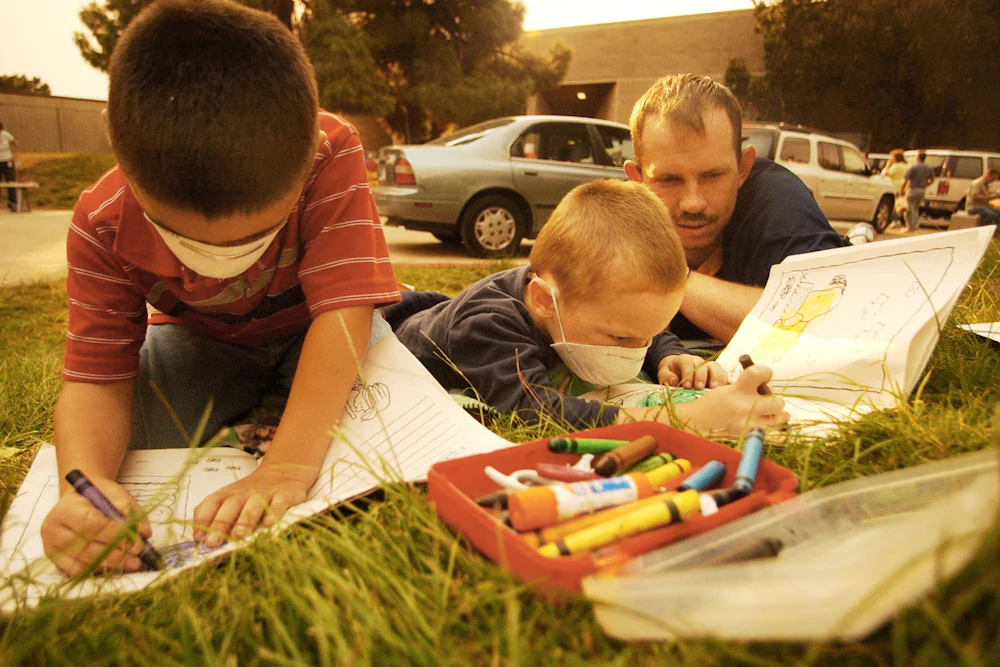
Four-year-olds wear face masks during California
 wildfires in 2003; similar difficulties are facing
 many Australians, including children, during the present bushfire crisis.
Joining the two may seem arbitrary at first glance, but there’s a compelling moral case for funneling carbon tax revenue to educational and child-benefiting programs, even before one gets to the political payoff. Children are going to suffer disproportionately from the impacts of climate change. Reports estimate young children globally are going to suffer nearly 90 percent of the “disease burden” from climate change in terms of life-expectancy years lost, higher rates of disability, resurgence of previously dormant diseases, etc. This says nothing of the everyday impacts on childhood from having, for instance, far fewer days to play outside due to extreme heat and weather—or the effects of crop disturbance, home destruction, mass migration, and resource conflict throughout their lives.
It seems fair and just for children, therefore, to receive funds to help compensate for these damages.

Read the story from The New Republic by Elliott Haspel - “Give Kids the Money From Carbon Taxes.”

04 January, 2020

Need to cut carbon emissions

John Pettigrew, Bunbartha Climate Reality Australia Farmers for Climate Action Goulburn Valley Environment Group president
John Pettigrew.
Time is running out for any hope of stabilising runaway climate change that will severely impact the wellbeing of our children, grandchildren and future generations.
I carefully use the phrase ‘‘stabilise climate change’’, for any thought of being able to return to past climates is impossible for hundreds if not thousands of years.
As one example of future impacts, consider Australia’s current fire season — a catastrophic season by any measurement, but predicted to increase by up to a factor of four by the end of this century due to climate change. These are not my words but the words of Professor Mark Howden, director of the Climate Change Institute at the Australian National University.
The frequency of these frontal systems is projected to increase, as is our hotter and dryer landscape condition; but what good is talk, you ask?
Talk can at times be no more than symbolic; however, it is also possible that talk can lead to real actions individually, by communities or one would hope by our three levels of government. We need to convince world governments of the urgency and need to collectively work together to reduce carbon emissions into the atmosphere. That convincing starts with each of us talking to our elected representatives.
With the latest climate conference in Madrid breaking up with little if any advancement, now is the time to put pressure on global governments reluctant to support realistic global action.
We can identify some of these recalcitrant nations easily, with the United States, for example, dramatically withdrawing from the Paris agreement. China and India, developing countries with growing economies and emissions, need to do more, but the negative role Australia has played, starting at Kyoto and through to the latest round of discussions at COP25 in Madrid, is not fully understood.


Australia undermined (reduced) genuine global emission targets at Kyoto and most recently in Madrid declared it will use an accounting loophole to minimise its carbon reduction obligations through to 2030.
We desperately need to talk to all levels of government to bring pressure on Australia at international level to play our part in reducing carbon emissions and put pressure on nations that have the ability to significantly reduce emissions to do so. And let’s not forget why this talk is necessary: to constrain carbon emissions to levels that will not lessen impacts being now experienced, but to hopefully reduce the growth of the most catastrophic of impacts on future generations.
We owe it to our families and future generations to at least try.

Letter in The Shepparton News from John Pettigrew - “Need to cut carbon emissions.”

20 November, 2019

Climate Change Poses Threats to Children’s Health Worldwide

The health effects of climate change will be unevenly distributed and children will be among those especially harmed, according to a new report from the medical journal The Lancet.
The report compared human health consequences under two scenarios: one in which the world meets the commitments laid out in the Paris Agreement and reins in emissions so that increases in global temperatures remain “well below 2 degrees Celsius” by the end of the century, and one in which it does not.
The report, published Wednesday, found that failing to limit emissions would lead to health problems caused by infectious diseases, worsening air pollution, rising temperatures and malnutrition.
“With every degree of warming, a child born today faces a future where their health and well-being will be increasingly impacted by the realities and dangers of a warmer world,” said Dr. Renee N. Salas, a clinical instructor of emergency medicine at Harvard Medical School and lead author of the United States policy brief that accompanied the report.

Read the story from The New York Times by Kendra Pierre-Louis - “Climate Change Poses Threats to Children’s Health Worldwide.”

21 September, 2019

Children, stop yelling at me, or I will make certain the climate changes for the worse

CHILDREN, THINK VERY CAREFULLY ABOUT YOUR NEXT MOVE.
Children! Have you not enjoyed plastic straws to your heart’s contentment? (Michael Reynolds/EPA-EFE/REX)
Children! Have you not enjoyed plastic straws to your heart’s contentment? 
I walk in the halls of power. I wield votes. I enter smoke-filled rooms to which you complain that you lack access, although, at the rate things are going with the climate, soon you will have access to smoke-filled rooms, too. Every room! Even outdoors!
But you seem, somehow, not to get it. You seem to think I am someone you might want to lecture and argue with and protest and even, perhaps, alienate.
I hope I do not have to say this more than once: I have nothing to lose. So think very carefully about what you will do next. I may not live to see the enormous wave that engulfs your coastal cities, but that does not mean I will not have caused that wave.
Think to yourself about the following sentence: “The congressman fought hard to protect the earth that would be occupied by future generations, generations for whom the congressman had nothing but respect because they had never appeared to bother the congressman when he was just trying to have a nice afternoon and not be asked frustrating questions.”

Read the opinion piece from The Washington Post by Alexandra Petrie - “Children, stop yelling at me, or I will make certain the climate changes for the worse.”

23 February, 2019

Swedish student leader wins EU pledge to spend billions on climate

BRUSSELS, Feb 21 (Reuters) - The European Union should spend hundreds of billions of euros combating climate change during the next decade, its chief executive said on Thursday, responding to a Swedish teen who has inspired a global movement of children against global warming.
Teenage Greta Thunberg said she and hundreds of thousands
like her were skipping school each week to focus politicians'
minds on a 2020 deadline for countries to step up planned emissions cuts.
In a speech alongside 16-year-old Greta Thunberg in Brussels, European Commission President Jean-Claude Juncker also criticised U.S. President Donald Trump for suggesting climate change was "invented" and “ideological".

"In the next financial period from 2021 to 2027, every fourth euro spent within the EU budget will go towards action to mitigate climate change," Juncker said of his proposal for the EU budget, which is typically 1 percent of the bloc's economic output, or 1 trillion euros ($1.13 trillion) over seven years.

"Mr. Trump and his friends believe that climate change is something that has just been invented and its an ideological concept, but ... something dangerous is already underway," Juncker said.

Thunberg was in Brussels to join a seventh week of demonstrations by Belgian children skipping school to protest against global warming.


Read the Reuters story by Clare Roth  - “Swedish student leader wins EU pledge to spend billions on climate.”

23 October, 2018

If Everyone Ate Beans Instead of Beef

Ecoanxiety is an emerging condition. Named in 2011, the American Psychological Association recently described it as the dread and helplessness that come with “watching the slow and seemingly irrevocable impacts of climate change unfold, and worrying about the future for oneself, children, and later generations.”
Soybeans in a silo at a cattle feed in the Amazon rainforest in Brazil.
It’s not a formal diagnosis. Anxiety is traditionally defined by an outsized stress response to a given stimulus. In this case, the stimulus is real, as are the deleterious effects of stress on the body.

This sort of disposition toward ecological-based distress does not pair well with a president who has denied the reality of the basis for this anxiety. Donald Trump has called climate change a fabrication on the part of “the Chinese in order to make U.S. manufacturing non-competitive.” He has also led the United States to become the only G20 country that will not honor the Paris Climate Accord, and who has appointed fossil-fuel advocates to lead the Department of Energy and Environmental Protection Agency.


Read the story from The Atlantic by James Hamblin  - “If Everyone Ate Beans Instead of Beef.”

29 May, 2018

Pediatricians are concerned about climate change, and here's why

Doctors have long raised alarm about the potential health risks of climate change, but it turns out that children are particularly vulnerable.

Children are estimated to bear 88% of the burden of disease related to climate change, according to a paper published Tuesday in the journal Pediatrics.

The new paper highlights some studies on the implications of climate change for children's health and then calls for the world to better prepare for these health risks, not just in the future but in the present.


Read the CNN story by Jacqueline Howard - “Pediatricians are concerned about climate change, and here's why.”

22 July, 2017

North Koreans undernourished, in worst drought in 16 years

London: North Korea is facing severe food shortages due to the worst drought since 2001, with food imports needed to ensure children and the elderly do not go hungry, the United Nations' food agency says.
People walk and cycle past a factory dome with writing which reads "First priority: self-development" in Hamhung, North ...
People walk and cycle past a factory dome with
writing which reads "First priority: self-development"
in Hamhung, North Korea, on Thursday. 
The Food and Agriculture Organisation (FAO) said rainfall in key producing areas fell well below the long-term average between April and June and badly affected staple crops including rice, maize, potatoes and soybean.
This disrupted planting activities and damaged the 2017 main season crops, requiring
 increased food imports, commercial or food aid  over the next three months to ensure adequate food supplies for the most vulnerable, including children and the elderly.


Read Ben Seabrook’s story in today’s Melbourne Age - “North Koreans undernourished, in worst drought in 16 years.”

23 March, 2017

Why I decided to never have children

Ruby Hamad - "I don't have
kids and I never will".
I don't have kids, and I never will. I decided that years ago. According to pundits, politicians, and pontiffs, this makes me selfish. They couldn't be more wrong.

Recently, US Republican Steve King warned of the "population time bomb" putting civilisation itself under threat by way of Muslims having more babies than white Europeans. And now, businessman and Fairfax columnist Harold Mitchell has opined on why it is imperative and patriotic for Australians to commit to having more children.


Read Ruby Hama’s story in The Sydney Morning Herald - “Why I decided to never have children.”

03 June, 2015

Stanley wants GPs and specialists to prepare for inevitable deluge of sickness


G

Professor Fiona Stanley - she wants GPs
and specialists to be prepared for the
inevitable increase climate change
will mean for childhood sickness.
Ps and specialists need to train and prepare for the “inevitable increase” in childhood sickness and pressure on health services linked to climate change, leading epidemiologist Professor Fiona Stanley says.

A new report on child health and climate change, released by Doctors for the Environment Australia (DEA), warns that Australia’s federal and state governments must take immediate steps to curtail rising global temperatures or risk an increased burden of disease, particularly for children.

The report, No Time for Games: Children’s Health and Climate Change, presents key research findings that predict a frightening future for children and the healthcare system.

Read story published by Doctors for the Environment, Australia - “Grim future for children: global warming report”.

07 April, 2015

Six degrees of warming by the end of the century - PriceWaterhouseCoopers


That radical green pressure group PriceWaterhouseCoopers warns that even if the present rate of global decarbonisation were to double, we would still be on course for 6C of warming by the end of the century.

“Confining the rise to 2C requires a sixfold reduction in carbon intensity: far beyond the scope of current policies.”

So says George Monbiot in his latest piece in The Guardian headed: “If children lose contact with nature they won't fight for it”.

“So where are the marches, the occupations, the urgent demands for change?,” he asks.

25 January, 2015

Forceful comments underlined with mockery by U.S. President


President Barack Obama made some of his most forceful comments to date about global warming in his 2015 State of the Union address.

The U.S. president mocked the Republican reluctance to acknowledge man-made climate change and warning Congress against attacking his efforts to curtail greenhouse gas emissions.

Obama spoke about climate change late in the 63-minute long speech. But his rhetoric was blunt. "No challengeno challengeposes a greater threat to future generations than climate change," he said. "That's why, over the past six years, we've done more than ever before to combat climate change, from the way we produce energy, to the way we use it...And that's why I will not let this Congress endanger the health of our children by turning back the clock on our efforts."

Inside Climate News writes about President Obama in a story headed: “A Defiant Obama Asserts Climate Agenda With Firmness and Mockery”.

18 November, 2012

Climate change will disrupt everything, including the engagement of kids with nature


Warren McLaren explains that most adults climbed trees and played outdoors when they were children.

Warren McLaren's picture explains perfectly
 how kids engage with nature in an
 unstructured way.
“But,” he writes on the ABC Environment, “Today's young people don't play outdoors like their parents. It's an omission with grave implications.”

Writing in his story headed: “Without nature, the little children suffer”, McLaren turns to a comment from famous American philosopher, Henry David Thoreau, who said: "In wildness is the preservation of the world", to help illustrate his argument.

It is human activities that are causing the difficulty that McLaren points to in that we are decimating the world’s species and it is those same activities that are worsening the impact of climate change.

24 May, 2012

Hans Rosling helps us understand population growth


Considering Saturday’s discussions Beneath the Wisteria about population, this Ted Talk by Hans Rosling: “Religions and babies”, seems remarkably relevant.

Supporter, Brad Cole, alerted us to the Rosling presentation.


Hans Rosling.
Rosling asks: “Do some religions have a higher birth rate than others -- and how does this affect global population growth?”

Speaking at the TEDxSummit in Doha, Qatar, he graphs data over time and across religions. With his trademark humor and sharp insight, Hans reaches a surprising conclusion on world fertility rates.

In Hans Rosling’s hands, data sings. Global trends in health and economics come to vivid life. And the big picture of global development—with some surprisingly good news—snaps into sharp focus.

He concludes: “The number of children [per family] is not growing any longer in the world. We are still debating peak oil, but we have definitely reached peak child.”

17 April, 2012

George talks about 'Rewilding our children'


George Monbiot (left) writes a column in Great Britain’s Guardian newspaper and recently became a dad.

He writes about that in his latest piece – “Rewilding Our Children: Hope for humanity lies inrecognising their animal nature”.