Showing posts with label clear. Show all posts

31 December, 2019

These bushfires are a historic event. Here is what we should learn from them

With the ongoing bushfire crisis, it is clear that we are in the middle of a historic event that will change the way we manage fire in the Australian environment.
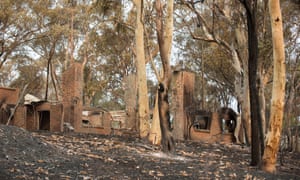
A house destroyed in the New South Wales bushfires
We need to look at where and how we build houses
to withstand bushfires in a hotter and drier world.
As a bushfire protection scientist, I am mostly focused on the practical problems these major events have given rise to, what went wrong or right, how we can solve these and prepare for the future.
My personal perspective is based on working as a fire protection planner in the aftermath of the 2003 Canberra fires and the 2009 Victorian Black Saturday fires. These events resulted in significant changes to how we protect communities, which have been successful in a lot of cases. There are still several months to run in the current fire season, but we can already start to look to the big questions that we will need to answer once the fires are finally out.
We fight fires with data as much as water these days. Apps and social media are now an essential part of warning communities and coordinating evacuations. While this is an amazing capability that simply did not exist at the time of the Canberra and Victorian fires, it was clear from tweets by fire protection experts, such as Bianca Nogrady in the Blue Mountains, that our telecommunications system was being pushed to its absolute limit as people tried desperately to keep on top of where the fires were. 

Read the story from The Guardian by Cormac Farrell - “These bushfires are a historic event. Here is what we should learn from them.”

11 April, 2019

Adani still has a long march ahead before its Carmichael coal mine opens.

The final approval for Adani's plans to develop a coal mine in Queensland's Galilee Basin looks likely to come well after the federal election, with a slew of state and federal hurdles to clear.
Not about to depart centre stage: An anti-Adani protester
about to be led away after interrupting Prime Minister Scott
Morrison's speech in Brisbane on Monday.
Supporters of the Carmichael mine were buoyed by Tuesday's announcement that federal Environment Minister Melissa Price had ticked off the mine's controversial groundwater plans.

The mine - intended to extract 15 million tonnes of coal a year in its first stage for a $2 billion outlay - was one major step closer to getting started, they hoped.


Read the story from The Age by Peter Hannam and Felicity Caldwell - “Adani still has a long march ahead before its Carmichael coal mine opens.

Climate Change’s Giant Impact on the Economy: 4 Key Issues

By now, it’s clear that climate change poses environmental risks beyond anything seen in the modern age. But we’re only starting to come to grips with the potential economic effects.
Wading through flood waters from Tropical Storm Harvey
in Houston in August 2017. “We know we can adapt to slow
 changes,” a Yale economist said. “Rapid changes are the ones
that would be most damaging and painful.”
Using increasingly sophisticated modeling, researchers are calculating how each tenth of a degree of global warming is likely to play out in economic terms. Their projections carry large bands of uncertainty, because of the vagaries of human behavior and the remaining questions about how quickly the planet will respond to the buildup of greenhouse gases.

A government report in November raised the prospect that a warmer planet could mean a big hit to G.D.P. in the coming decades.


Read the story from The New York Times by Neil Irwin - “Climate Change’s Giant Impact on the Economy: 4 Key Issues.”

14 November, 2018

Government under fire over rush to promote new power generation

The Morrison government has copped a blast for calling for expressions of interest in new power generation projects before it is clear that any enabling legislation can clear the parliament before the next federal election.
The government is pressing ahead with proposals
 to underwrite new power generation.
The Australia Institute has used a submission to a government consultation process to criticise the government for “building the process while running it” – pointing out the Coalition is calling on interested parties to pitch projects before the parliament has set up the necessary policy framework – a procedure “which poses a number of risks”.

The energy minister, Angus Taylor, has suggested the government may underwrite investment in new power generation and indemnify coal projects against the future risk of a carbon price.

Labor has signalled it would not support either form of taxpayer intervention. The opposition has also been sharply critical of other elements of the government’s latest energy foray, which indicates the Coalition is unlikely to land a bipartisan consensus on a package which has already triggered a strong backlash from stakeholders.


Read the story from The Guardian by Katharine Murphy - “Government under fire over rush to promote new power generation.”

28 July, 2018

How Far Can We Get Without Flying?

I’m a climate scientist who doesn’t fly. I try to avoid burning fossil fuels, because it’s clear that doing so causes real harm to humans and to nonhumans, today and far into the future. I don’t like harming others, so I don’t fly. Back in 2010, though, I was awash in cognitive dissonance. My awareness of global warming had risen to a fever pitch, but I hadn’t yet made real changes to my daily life. This disconnect made me feel panicked and disempowered.

Then one evening in 2011, I gathered my utility bills and did some Internet research. I looked up the amounts of carbon dioxide emitted by burning a gallon of gasoline and a therm (about 100 cubic feet) of natural gas, I found an estimate for emissions from producing the food for a typical American diet and an estimate for generating a kilowatt-hour of electricity in California, and I averaged the Intergovernmental Panel on Climate Change and Environmental Protection Agency estimates for CO2 emissions per mile from flying. With these data, I made a basic pie chart of my personal greenhouse gas emissions for 2010.


Read the story by Peter Kalmus from Yes! Magazine - “How Far Can We Get Without Flying?

06 December, 2017

Don’t go in the water, Environment Protection Authority warns

Don't go swimming at Melbourne's beaches today – it could make you sick.
It's best to keep out of the water at Melbourne's beaches. 
That's the message from the authorities, who are urging people to steer well clear of every Port Phillip beach as the bacteria-filled runoff from the weekend's storms pours into the bay.

Indeed it may not be safe to swim tomorrow or right through the weekend.

The Environment Protection Authority is doing water-quality testing on Tuesday, which will determine how bad things are in the bay and how long people should avoid the water.


Read Liam Mannix’s story in today’s Melbourne Age - “Don’t go in the water, Environment Protection Authority warns.”

08 October, 2017

The Anthropocene: Has human impact changed Earth forever?

Despite our early existence compared to Earth’s age (humans have only been around for 200.000 years, whereas the planet emerged 4.6 billion years ago), the mark we are leaving on our world is already pretty obvious.

We’ve started by chopping down trees in order to clear the land for agriculture. Then we’ve settled permanently and created the first civilisations, that is to say, the first cities. We have also managed to develop complex technologies and learned how to use external sources of energy, including fossil fuels, with consequences we would soon find out.
And it was over the last two centuries which cover the Industrial Revolution (18th century) and “The Great Acceleration” onset around the 1950’s that the global effects of human activities have become clearly noticeable.

Humanity has brought about such a planetary change that Paul Crutzen, a Dutch Nobel laureate chemist, could no longer agree that he was living in the Holocene the current geological epoch which began around 10.000 years ago. So back in 2000, he and a colleague, Eugene Stoermer, decided to coin what they considered to be the new geological epoch we were entering as the Anthropocene the age of man.


07 June, 2015

Science is clear and unequivocal; politics is opaque and subjective


A

ustralia "Will make a strong, clear and ambitious contribution to the post-2020 target," according to Environment Minister Greg Hunt.

Greg Hunt - promises in
 the face of criticism.
The Minister’s response follows serious questioning from the United States, South Africa and China who doubted whether Australia's climate policies were adequate at the UN Framework Convention on Climate Change.

“Strong, clear and ambitious” sounds wonderful politically, but scientifically it is woefully inadequate, unless Mr Hunt envisages reductions in carbon dioxide emissions of more than seventy per cent.

The science is clear and unequivocal; politics is opaque and subjective.

The ABC tells us more about what happened in Germany in its story - “Coalition defends climate change policies after grilling from US, China, South Africa at UN meeting”.

01 October, 2013

Support should be cause for celebration


Beneath the Wisteria supporters should be celebrating.

Much has happened since the recent election of the Tony Abbott led  coalition government about which we could be sad, but ample is happening illustrating that public opinion is changing and soon the calls to mitigate our carbon dioxide emissions will be loud, clear and unequivocal.

The Melbourne Age has long been a supporter of the need for action and today (October 1) its editorial “Besides the climate science, we need action” is further evidence of this groundswell.