Showing posts with label powerful. Show all posts

02 April, 2018

Ticks rising - lyme disease the first epidemic of climate change

Evolution has endowed the big-footed snowshoe hare with a particularly nifty skill. Over a period of about 10 weeks, as autumn days shorten in the high peaks and boreal forests, the nimble nocturnal hare transforms itself. Where it was once a tawny brown to match the pine needles and twigs amid which it forages, the hare turns silvery white, just in time for the falling of winter snow. This transformation is no inconsequential feat. Lepus americanus, as it is formally known, is able to jump 10 feet and run at a speed of 27 miles per hour, propelled by powerful hind legs and a fierce instinct to live. But it nonetheless ends up, 86 per cent of the time by one study, as a meal for a lynx, red fox, coyote, or even a goshawk or great horned owl. The change of coat is a way to remain invisible, to hide in the brush or fly over the snow unseen, long enough at least to keep the species going. 
In a warming world, ticks thrive inmate places than ever before,
making lyme disease the first epidemic of climate change.

Snowshoe hares are widely spread throughout the colder, higher reaches of North America – in the wilderness of western Montana, on the coniferous slopes of Alaska, and in the forbidding reaches of the Canadian Yukon. The Yukon is part of the Beringia, an ancient swathe of territory that linked Siberia and North America by a land bridge that, with the passing of the last Ice Age 11,000 years ago, gave way to the Bering Strait. All manner of mammals, plants and insects ferried east and west across that bridge, creating, over thousands of years, the rich boreal forest. But in this place, north of the 60-degree latitude, the axiom of life coloured by stinging cold, early snow and concrete ribbons of ice has been upended in the cosmic blink of an eye. The average temperature has increased by 2 degrees Celsius in the past half century, and by 4 degrees Celsius in the winter. Glaciers are rapidly receding, releasing ancient torrents of water into Kluane Lake, a 150-square-mile reflecting pool that has been called a crown jewel of the Yukon. Lightning storms, ice jams, forest fires, rain – these things are suddenly more common. Permafrost is disappearing.


Read the Aeon story by Mary Beth Pfeiffer - “Ticks rising.

23 February, 2018

Climate change prompts idea for new cyclone classification

Increasingly powerful cyclones driven by climate change may require a new classification for the storms, category 6.

Cyclone Winston which hit Fiji in 2016 had winds exceeding 230km/h which was the highest margin of a category 5 cyclone, Climate Change Minister James Shaw told Radio NZ.

The Pacific Climate Change Conference is underway in Wellington, attended by politicians, scientists and policymakers.


Read the story from The New Zealand Herald - “Climate change prompts idea for new cyclone classification.”

20 February, 2018

Frydenberg, IPA trolling renewables on ABC’s Q&A - again

The Coalition and the powerful right-wing lobby groups that help direct their policies show no signs of backing off in their campaign against renewables – or any other technology, for that matter, that might usher in a cleaner, cheaper and more reliable grid.
Monday night’s Q&A panelists, including federal energy
 minister Josh Frydenberg and, second from right, Simon Breheny,
the director of policy at the Institute of Public Affairs.
Craig Kelly has distinguished himself on EVs, a sweaty George Christensen on Facebook rails against anything Green or anti-coal, and Matt Canavan continues to wage a war on behalf of the coal industry.

On Monday, on ABC’s Q&A program, they were at it again: energy minister Josh Frydenberg and the Institute of Public Affairs teaming up to demonise renewables, and to propose some hopelessly unrealistic solutions to Australia’s energy trilemma.

It cannot go without comment.

Read the RenewEconomy story by Giles Parkinson - “Frydenberg, IPA trolling renewables on ABC’s Q&A - again.”

31 October, 2017

The Geoengineering Fallacy

Geoengineering technologies are not yet deployable globally, but support for them is advancing fast, thanks to backing by powerful advocates eager to start experiments. But no silver bullet for climate change exists, and we must not abandon proven methods for the sake of a promise that one will be found.

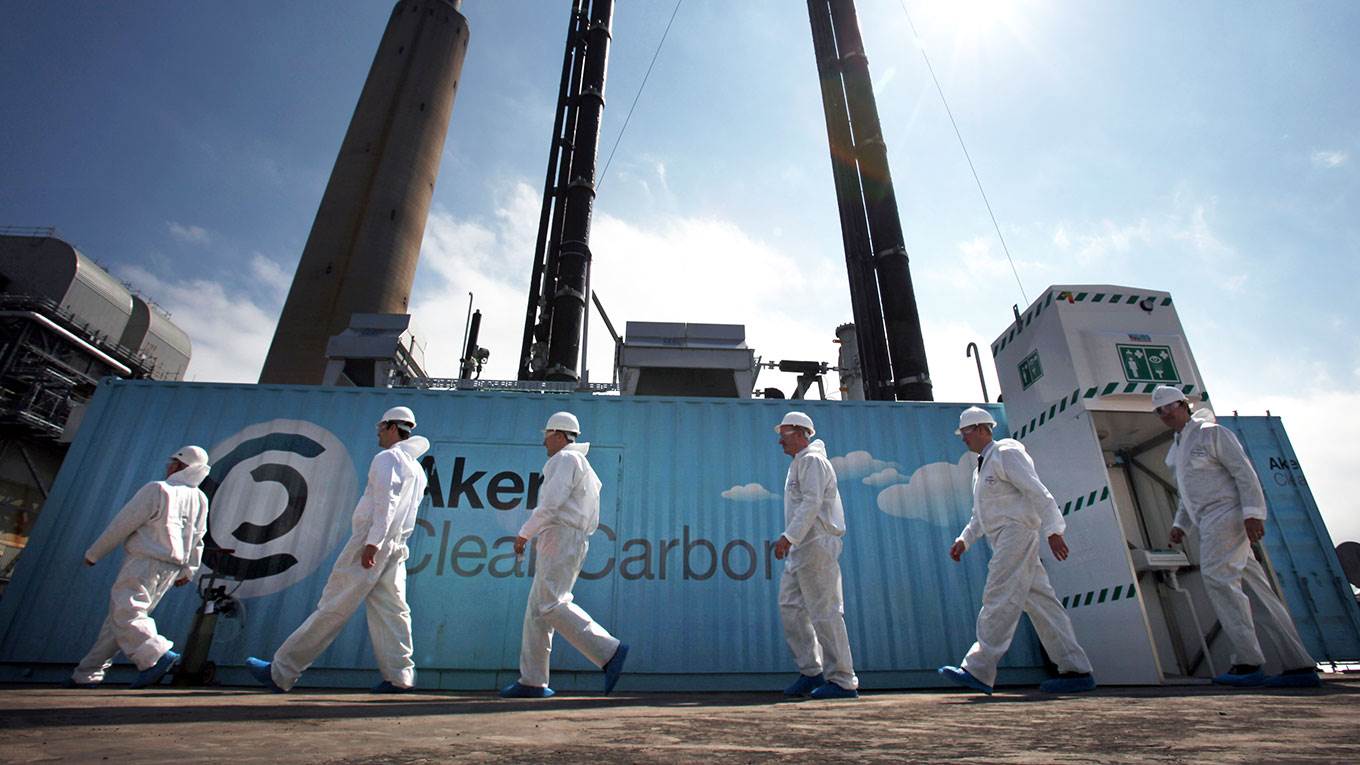
Scientists stand beside a new carbon capture test unit

BERLIN – As the world struggles to rein in emissions of climate-changing gases and limit planetary warming, a new technological silver bullet is gaining supporters. Geoengineering –the large-scale manipulation of the Earth’s natural systems – has been popularized as a means of counteracting the negative effects of climate change.

Proponents of this science feed the illusion that there is a way to engineer an exit from the climate crisis, meet the goals of the 2015 Paris climate agreement, and maintain a consumption-heavy lifestyle.


Read the Project Syndicate story by Barbara Unmüßig - “The Geoengineering Fallacy.”

23 May, 2014

The seriousness of climate change ecliped by fantasy, again!


Indisputable evidence that many in powerful places are not sufficiently intellectually equipped to understand the seriousness and consequences of climate change is illustrated in a Huffington Post story.

The story, headed: “House Science Committee is more worried about aliens than climate change” reports that the chairman of the House Science, Space and Technology Committee has spent more time studying existence of extra-terrestrial life than it has examining climate science or the repercussions of global climate change.

17 January, 2014

Climate change falls in and out of favour with the media


Sadly, climate change is one of the things that fall in and out of favour.

As recent as 2009, people all around the world were taking note and would have acted, had they then been asked and not been swayed by the powerful lobby groups funded via the deep pockets of the fossil fuel industries.

It was about then that the media was alive with discussion about the causes of, and complications arising from climate change, but now the mood has changed.

Coverage of climate change, at least on American news services and happenings there probably reflect the Australian market, peaked in 2009 and then dropped significantly from there.

That significant change in priorities is explained in a story published on the Huffington Post headed: “This is how little time television news devotes to climate change”.

The twist is that while TV coverage of climate change has dropped significantly, the evolving catastrophic change humanity faces from this human-induced injury to our atmosphere has not, rather the reverse is true as climate change is tightening its grip on the world.