Showing posts with label world leaders. Show all posts

25 January, 2020

As Trump melted into the background at Davos, one big new climate idea stood out

London: Something strange happened this week: for the first time in a long time, Donald Trump wasn't the main attraction at a gathering of world leaders. The circus had lost its ringmaster.
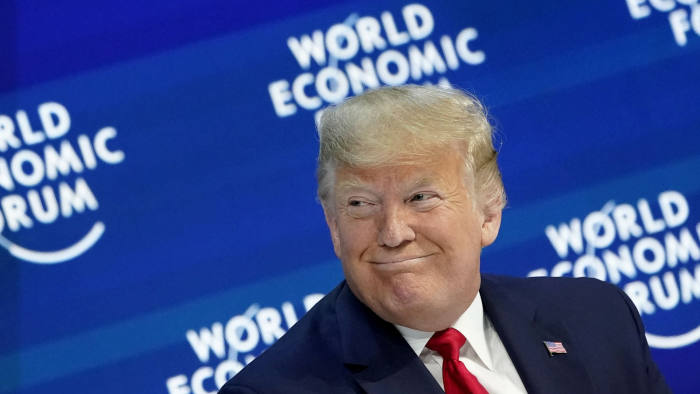
Image result for trump at davos
President Donald Trump tells the World Economic
Forum in Davos that 'we must reject the perennial
prophets of doom'. Instead of focusing on climate
change, Trump opted to use the global stage
 to highlight the US economy's strength.
It wasn't from lack of trying. The US President blew into the World Economic Forum at Davos and quickly sprayed environmental activists like Greta Thunberg as "prophets of doom" and made the outlandish claim that America was enjoying an economic boom "likes of which the world has never seen". He threw a cluster of attention-seeking bombs but the spotlight just wouldn't stick.
Truth is the master showman's attention was elsewhere. He may have been in Switzerland but the Eurosceptic's eyes were focused on his impeachment trial in Washington and the rapidly approaching November election. Any new major international confrontations would have to wait.
It meant the adults in the room could get on with the job, free from the fallout of any Trump-shaped sideshow. The doom and fear that once dogged Davos gave way to intelligent debate and even some rare optimism about the economy following years of stagnant growth and damaging trade spats.

Read the story from The Age by Bevan Shields - “As Trump melted into the background at Davos, one big new climate idea stood out.”

15 December, 2019

As U.N. Climate Talks Go to Overtime, a Battle for the ‘Spirit’ of the Paris Pact

MADRID — After two weeks of contentious negotiations, world leaders put in charge of averting a cluster of accelerating climate threats remained at loggerheads late Saturday about whether they could commit, just on paper, to raise voluntary climate targets next year.
Credit...
The annual talks, formally known as the Conference of Parties, which had been scheduled to end on Friday, were meant to hammer out the final details of the landmark 2015 Paris climate accord, and expectations initially ran high that they would yield a collective political call for raising climate targets. 
That is vital for the future of millions. With greenhouse gas emissions on their current trajectory, average global temperatures are on pace to increase to levels where heat waves are very likely to intensify, storms are set to become more severe, and coastal cities are at risk of drowning, according to scientific consensus.

Read the story from The New York Times by Somini Sengupta - “As U.N. Climate Talks Go to Overtime, a Battle for the ‘Spirit’ of the Paris Pact.”

29 November, 2019

‘Bleak’ U.N. Report on a Planet in Peril Looms Over New Climate Talks

With world leaders gathering in Madrid next week for their annual bargaining session over how to avert a climate catastrophe, the latest assessment issued by the United Nations said Tuesday that greenhouse gas emissions are still rising dangerously.
“The summary findings are bleak,” said the annual assessment, which is produced by the United Nations Environment Program and is formally known as the Emissions Gap Report. Countries have failed to halt the rise of greenhouse gas emissions despite repeated warnings from scientists, with China and the United States, the two biggest polluters, further increasing their emissions last year.
The result, the authors added, is that “deeper and faster cuts are now required.”
As if to underscore the gap between reality and diplomacy, the international climate negotiations, scheduled to begin next week, are not even designed to ramp up pledges by world leaders to cut their countries’ emissions. That deadline is still a year away. 

Read the story from The New York Times by Somini Sengupta - “‘Bleak’ U.N. Report on a Planet in Peril Looms Over New Climate Talks.”

27 September, 2019

How Oceans Rise and Die on a Warming Planet

In a Park Hyatt hotel ballroom in midtown Manhattan, on Wednesday, Greta Thunberg, the sixteen-year-old climate activist, stood before world leaders and delivered a goosebump-inducing speech. The occasion was the release of “The Ocean and Cryosphere in a Changing Climate,” a major scientific report by the U.N.’s Intergovernmental Panel on Climate Change, which concluded that human activities have made the oceans increasingly inhospitable to marine life and have caused glacial melt and sea-level rise to happen at an even faster rate than scientists had previously projected. The effects—already well underway, with some locked in over the next century—pose an immediate threat to the survival of certain island nations and high-alpine communities, as well as hundreds of millions of other coastal inhabitants and many of the world’s fisheries. “The reason we have taken to the streets is because of science,” Thunberg said, after thanking the U.N. scientists who authored the report. “This is about an existential crisis for the biosphere and for humanity.” On the projection screen behind her was a seal stranded on a tiny iceberg in a big blue ocean. “Our main enemy now is physics. We can still fix this, it is still possible, but not if we continue like now.” She concluded, “We must listen to the scientists.”
Flooding in Houston, Texas, after Hurricane Harvey. A new report from the
 I.P.C.C. is the first to comprehensively tie together ocean acidification,
 glacial collapse, and sea-level rise.
The report, which is based on nearly seven thousand peer-reviewed studies, was prepared and written by a hundred and four scientists from thirty-six countries. It was the latest addition in a dire trilogy of I.P.C.C. special reports, which previously included studies on the extreme risks of even 1.5 degrees Celsius of warming and on the impacts of climate change on land. (Additionally, the Intergovernmental Science-Policy Platform on Biodiversity and Ecosystem Services, a U.N.-backed body, released a report in May on the accelerating rate of widespread extinction across species.) Wednesday’s report took a similarly comprehensive approach to studying climate change’s impact on ice formations, sea level, and the planet’s oceans.


Read the story from The New Yorker by Carolyn Cornman -  “How Oceans Rise and Die on a Warming Planet.”

14 July, 2019

Hague climate change judgement could inspire a global civil movement

You have been negotiating all my life”, cried out 21-year-old Anjali Appadurai from the lectern of a UN climate change conference four years ago. The activist, speaking on behalf of her nation’s youth, could have been speaking for anyone who has taken a mild interest in more than two decades of international negotiations on climate change and stood aghast as world leaders have failed to protect the most basic of human rights – to exist.
Urgenda’s legal team celebrate on Wednesday after court ruling
 in the Hague that ordered the Dutch government to cut
emissions by 25% within five years.
But today, thanks to 886 Dutch citizens who decided to sue their government, all of that may change. We may not have to wait for the politicians to save us – the lawyers may step in instead. In the first successful case of its kind, a judge in the Hague has ruled that the Dutch government’s stance on climate change is illegal and has ordered them to take action to cut greenhouse gas emissions by a hefty 25% within five years.

Read the story from The Guardian by Emma Howard - “Hague climate change judgement could inspire a global civil movement .”

03 June, 2019

United Nations Says 80 Countries May Ramp Up Climate Pledges

UNITED NATIONS — About 80 countries want to increase their climate pledges ahead of schedule under the Paris climate accord, the United Nations said Tuesday, signaling that some of them would do so at a summit of world leaders in September.
United Nations Secretary-General António Guterres
 has made climate change a signature issue.
Luis Alfonso de Alba, a Mexican diplomat who is currently the United Nations Secretary General’s envoy on climate change, declined to say which countries were expected to announce higher climate ambitions, nor whether they would be enough to make a difference to the fate of the world.

Even if every country were to meet the pledges already made under the 2015 Paris agreement — and they are nowhere on track to do so — it would be insufficient to avert the worst effects of climate change. An “exponential increase in ambition,” Mr. de Alba said, is needed.


Read the story from The New York Times by Somini Sengupta - “United Nations Says 80 Countries May Ramp Up Climate Pledges.”

24 February, 2019

Gaslighting the climate-striking students

“First they ignore you, then they laugh at you, then they fight you, then you win,” a quote commonly misattributed to Gandhi, nevertheless encapsulates his understanding and that of many other social justice leaders. Given the recent attacks against hundreds of thousands of climate-striking students, though, it is clear that it misses a stage: right after they ignore you, they gaslight you.


Gaslighting means to manipulate someone’s perception of reality so that they doubt their own sanity. Right now, we are seeing world leaders, government ministers, editors of major media, all lining up to try to gaslight us, their citizens, the public. They want us to disbelieve our own eyes and ears, our own minds, reasoning and emotions because the alternative is simply impossible for them to bear. They cannot bear the fact, the reality, that a new generation is rising up and raising its voice, showing its power through striking and non-violent civil disobedience, demanding a habitable planet, and thus casting a bright spotlight on the older generation’s abject failure to curb the power of fossil-fueled industries and halt climate breakdown.

Read the story from Medium by Julia Steinberger - “Gaslighting the climate-striking students.”

16 December, 2018

This Secretive Chinese Mission Shows a Desperate Need for Environmental Agreements

There’s an iconic photo of Indian Prime Minister Narendra Modi deep in conversation with Chinese President Xi Jinping right before the two world leaders and historic opponents sign a peace declaration. The talks, which took place in April 2018, ended with a pledge between the two countries to “maintain peace and tranquillity in all areas of the India-China border region.” It was a historic agreement after years of political and military tensions over one of the most crucial and fragile ecosystems in the world.
The Tibetan Plateau sits in a rain shadow and, with
 an average annual snowfall of only 18 inches, is
dry for nine months of the year. Yet Tibet is the
source of several major rivers such as the Yangtze,
the Indus River, the Mekong, and the Ganges.
The China-India border, which stretches for 2,167 miles across the Himalayan region, is far from a tranquil place, though it attracts tens of thousands of mountaineers each year to brave its peaks. As humans progressively spoil the natural world, the impervious nature of the Himalayas has for centuries protected its forests, which are home to 360 unique songbird species, from mass tourism and industry.


09 October, 2018

World leaders 'have moral obligation to act' after UN climate report

World leaders have been told they have moral obligation to ramp up their action on the climate crisis in the wake of a new UN report that shows even half a degree of extra warming will affect hundreds of millions of people, decimate corals and intensify heat extremes.
 Hoesung Lee, chair of the IPCC, speaks during a press
conference at Songdo Convensia in Incheon on 8 October. 
But the muted response by Britain, Australia and other governments highlights the immense political challenges facing adoption of pathways to the relatively safe limit of 1.5C above pre-industrial temperatures outlined on Monday by the Intergovernmental Panel on Climate Change (IPCC).

With the report set to be presented at a major climate summit in Poland in December, known as COP24, there is little time for squabbles. The report noted that emissions need to be cut by 45% by 2030 in order to keep warming within 1.5C. That means decisions have to be taken in the next two years to decommission coal power plants and replace them with renewables, because major investments usually have a lifecycle of at least a decade.


Read the story by Jonathan Watts and Matthew Taylor from The Guardian - “World leaders 'have moral obligation to act' after UN climate report.”

25 September, 2017

This Girl's Letter To Trump Telling Him Climate Change Is Real Is So Poignant

The Earth is warming up and the weather is changing. Say what you will, but this year has shown that global warming and climate change can't be stopped if world leaders and citizens keep ignoring it. It's frustrating to know that people — especially those with power to make actual change — refuse to believe science when so many people are asking them to listen, and that includes kids. Although President Donald Trump won't listen to it, this girl's letter to Trump telling him climate change is real could have the power to make him and other people want to listen.

The girl's letter and Donald Trump.
The letter, written by an 11-year-old Austrian girl, was reportedly handed to Trump during the United Nations General Assembly last week — yes the same United Nations General Assembly where Trump taunted North Korea and called Kim Jung Un "rocket man." Instead of speaking to the world in a way that, according to CNN, "no American President" has ever done, maybe Trump could have paid attention to the letter gifted to him by Austrian President Alexander Van der Bellen, according to NDTV.


17 September, 2017

United Nations General Assembly: From North Korea to global terror threats, these are the issues on the agenda

Facing an escalating nuclear threat from North Korea and the mass flight of minority Muslims from Myanmar, world leaders will gather this week at the United Nations starting to tackle these and other tough challenges — from the spread of terrorism to a warming planet.
This will be US President Donald Trump's first
 time attending the UN General Assembly.
The spotlight will be on US President Donald Trump and France's new leader, Emmanuel Macron, who will both be making their first appearance at the General Assembly, which begins tomorrow.

They will be joined by more than 100 heads of state and Government, including Zimbabwe's President Robert Mugabe, one of Africa's longest-serving leaders who is said to be bringing a 70-member entourage.
These are the key issues to follow during the UN General Assembly, in no particular order:


17 April, 2016

Bringing Paris home - to Australia!

In December 2015, at the Paris Climate Change Conference, the world reached a universal agreement for tackling climate change. On 22 April 2016, world leaders will sign the Paris Agreement in New York and ensure it enters into force as soon as possible.

But for Australia, the gap between what this agreement demands of us and the level of commitments we currently have on the table remains extraordinarily wide. Australia continues to lag far behind other countries’ actions.

The months since Paris have delivered forceful reminders of what is at stake: temperature records have been shattered; the Great Barrier Reef has suffered unprecedented bleaching; Cyclone Winston brought devastation to Fiji; and a super-charged El Niño wrought havoc across our region.

Australia must act immediately to bring its actions into line with the goals of the Paris Agreement, including efforts to limit global warming to 1.5°C, providing adequate support to developing countries, and protecting the rights of vulnerable communities. Australia has all it needs to be part of today’s climate and energy solutions, and to create a brighter future for Australia and the world. A majority of Australians support stronger action, but big polluters, vested interests and failures of political leadership are holding us back.

As we approach the 2016 federal election, Australia needs a visionary plan of action to address climate change, and this should be at the heart of all parties’ agendas.

Read the Oxfam report – “Bringing Paris home.”

08 October, 2015

'Dear World Leaders, Take Climate Action Now'


A
round the world, people from all walks of life are standing together to demand a strong climate agreement in Paris and a healthy future for the planet.

It’s not often leaders from 195 countries meet in the same room together, but that is exactly what will happen in Paris this December at the twenty-first Conference of the Parties (COP 21) to the United Nations’ Framework Convention on Climate Change.

What’s the goal of COP 21? For world leaders to create the strongest global agreement possible to reduce greenhouse gas emissions

“Watch” this open letter on EcoWatch - “Dear World Leaders, Take Climate Action Now”.

(This is an emotional appeal to decency; an argument that people should be moral in their decision making; that world’s decision makers should put people ahead of profit and that in their altruism, they should care equally for others as they do for themselves. Will that happen? I’m pessimistic, but hopeful – Robert McLean).

03 May, 2015

Trench fighting about climate change itself is over, but the battle about response continues


by Robert McLean

T

rench fighting about the existence, the reality of climate change is over however, we are still in the trenches fighting about how we respond to this ever-worsening dilemma.

Any worthwhile attempt to avoid catastrophic climate change/global warming (or “climate ruin” as one pundit has suggested) hinges on an at least 80 per cent cut in the world’s greenhouse gas emissions.

Suggestions put forward to date, as honourable in intent as they are worthy of applause, are really little more than nibbling at the edges.

That 80 per cent cut, as dramatic as it might seem, is really just the beginning for the global aim should be zero emissions leading to the negative position before the end of this century.

It is argued that within five days of America entering World War Two, the country’s auto industry had swapped from producing consumer goods to military hardware.

That is a clear indication that with a sense of purpose and will we are able to engage with, undertake and make massive and significant changes to core human pursuits – any practical and worthwhile response to climate change will only be of any consequence if similar to what happened in the lead up to WWII.

Corporations effectively rule the world today – elected governments are theoretically in charge, but it is the corporations through their countless think-tanks and armies of lobbyists who actually pull the strings.

Arrival at an 80 per cent reduction of global GHG emissions will demand a war-like response, but being such a distant memory and so something about which most are unfamiliar, that it is impracticable and largely unachievable.

Like it or not, we are locked into what will be a struggle for human survival (that sounds dramatic, but until we are prepared to say it, from our leaders down will anything of any consequence happen) then we will continue to muddle along until we arrive at a catastrophic bifurcation in our lifestyles demanding action.

The tragedy is that as of today we (humans) have the capacity to make significant and meaningful changes to how we live and what we prioritize and in blindly charging forward, the time when we will need those resources is becoming inevitably closer and so we should be applying those reserves now and not expending them to such an extent that they will be rare, expensive and so hard, in not impossible to apply.

Writing on what is a wonderful autumn day, something being experienced by many of my Goulburn Valley counterparts it is difficult, if not impossible to suggest to people that rather dire times are ahead when a changing climate system is going to disrupt everything with which we are familiar.

Meanwhile, The Guardian reports that failure by the world leaders in Paris this year to reach a deal to cut carbon emissions would be catastrophic.

Its story - “Extreme weather and rising seas are already global threats. This will only intensify” – discusses the importance of the Paris meeting and the general nonchalant approach most people have to that crucial moment.

20 November, 2014

Definitive document, flexible principles


The sight the greeted G20
delegates telling them how
wonderful mining was in
Australia.
Participants in the recent G20 Summit in Brisbane were invited to Australia under the premise that they were to talk about growth, and they did.

Part of their welcome pack was a glossy brochure of more than 150 pages in which Australian Government leaders from the Prime Minister down clearly articulated that the summit would be unalterably about growth.

The G20 Brisbane 2014 “Delegate Publication” left little doubt in the minds of world leaders when Pages two and three combined for a double-page picture of three fully laden coal ships sat above the words: “Australian Mining – Australia’s $210 billion export powerhouse”.

The Minerals Council of Australia sponsored advertisement illustrated unequivocally that Australia’s future was linked to coal, emphazing recent observations from PM Tony Abbott that coal is good for humanity.

The final communique from the summit reflected the Australian treasurer Joe Hockey’s year-long plea for at least a two per cent growth in international gross domestic product.

The 150 page plus
brochure that all
delegates to the recent
 G20 Summit received.
Arrival at that final point was not, as it turned out, without its dramas, distractions and disruptions as the push for growth was for a moment almost obliterated when China and the U.S. announced on the eve of the summit they had made a game changing announcement about their intentions to actively mitigate circumstances that injure the world’s environment and so lead to climate change.

Climate change was never seen by the Australian Government as a legitimate issue for inclusion in summit discussions, although many nations understand and so realised that a benign climate was integral and necessary part of a the world’s economy.

Mr Abbott, who has been described as a former boss when he worked as a press secretary, as having ”very flexible principles” obviously talked with many world leaders over the last week or so and in today’s Melbourne Age said climate change was an important subject.

And so, it seems, our PM has gone from describing climate change as “crap” to seeing it as an “important subject.” Yes, he has “very flexible principles”.

This quite remarkable, and somewhat hard to believe change of heart came after discussion with French President François Hollande and that was reported by The Age in a story headed: “Abbott finds his French Connection on emission controls.”

03 January, 2014

Understanding our finite world


Gail Tverberg.
Allowing the reality that we live in a finite world to influence or impact on our thinking is equally forbidden as is publically discussing the meaning of life.

The latter has privately troubled philosophers and thinkers for millennia, but the finitude of our world is still not considered much by anyone, from world leaders to those next door.

However, an actuary interested in finite world issues – oil depletion, natural gas depletion, water shortages and climate change, Gail Tverberg had made something of a study of finitude.

In a story headed: “Why a finite world is a problem”, she helps us understand that oil limits looks very different from common expectations, with high prices leading to recession and low prices resulting in inadequate supply.

Gail gives eleven clear and irrefutable reasons why our finite world is a problem.